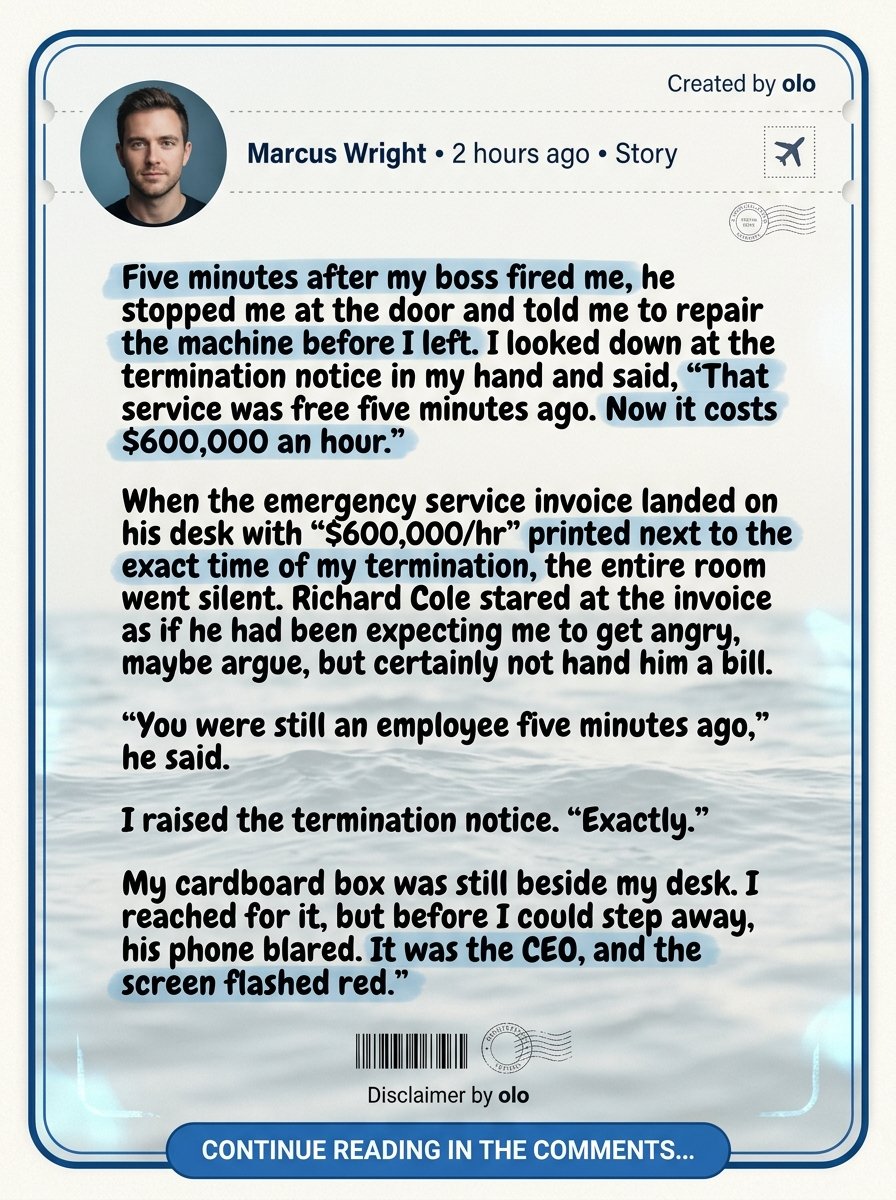
Richard Cole slammed the invoice onto his desk.
“Are you seriously trying to charge this company six hundred thousand dollars an hour?”
I calmly placed my termination notice beside it.
“No, Richard. I’m charging you the emergency rate for a service you requested after terminating my employment.”
He laughed, but there was no humor in it.
“You’ve worked here for eleven years. You don’t get to walk out and suddenly pretend you’re some outside contractor.”
I looked him straight in the eye.
“You made me an outside contractor when you fired me.”
Nobody in the conference room moved.
My name is Daniel Mercer. For eleven years, I’d been the senior engineer responsible for maintaining the company’s most critical manufacturing system. The machine wasn’t just expensive equipment. It was the heart of the entire production line.
When it ran, the company generated millions in revenue.
When it stopped, everything stopped.
I’d designed its emergency recovery protocol, trained the maintenance team, and personally prevented three catastrophic failures.
Richard knew all of that.
He also knew that I’d warned him repeatedly that the machine needed a major shutdown and overhaul.
But the overhaul was expensive, and Richard had quarterly targets to meet.
So he’d ignored my warnings.
Then, that morning, he called me into his office and told me my position was being eliminated as part of a “cost optimization initiative.”
Five minutes later, the machine failed.
And suddenly, the man who’d decided my salary was too expensive couldn’t imagine running the company without me.
“Daniel,” Richard said, lowering his voice, “let’s be reasonable. The machine is down. We have trucks waiting, customers threatening penalties, and a production line losing money every minute. Just fix it, and we’ll discuss your invoice afterward.”
I shook my head.
“Before I touch anything, I need written authorization, an approved emergency service agreement, and confirmation that your company accepts the rate.”
“You’re holding us hostage!”
“No. I’m protecting myself.”
I opened my cardboard box and placed my employee identification badge on the table.
“Your termination letter says my employment ended at 10:05 a.m. Your emergency service request came at 10:10 a.m. Those are your timestamps, not mine.”
Richard’s face turned red.
Then the plant manager, Susan, walked into the room carrying a tablet.
“Richard, we have another problem.”
He spun toward her.
“What now?”
“The backup system failed to engage. The machine is locked in a safety shutdown, and the manufacturer says the recovery process requires an engineer certified on the original installation.”
Susan looked at me.
“I’m told Daniel is the only person on-site with that certification.”
Richard slowly turned back toward me.
For the first time that morning, he looked genuinely frightened.
“How long will it take you to fix it?” he asked.
“If the damage is limited to the control system, perhaps two hours. If the emergency shutdown has damaged the drive assembly, it could take days.”
“And if we don’t fix it?”
I glanced at the production dashboard on the wall.
“Your losses will continue accumulating.”
He swallowed.
“Fine. Send me the paperwork.”
I slid a prepared emergency service agreement across the table.
He stared at the hourly rate.
“$600,000 an hour? That’s absurd!”
I pointed to the final paragraph.
“The rate applies to emergency mobilization, specialist labor, and liability assumed under the agreement. You can negotiate a different rate, but I won’t begin work until we agree on the terms.”
Susan leaned over his shoulder and read the document.
“Richard,” she said quietly, “we need the machine running.”
He picked up his pen.
But just before he signed, his eyes caught a line near the bottom of the agreement.
His expression changed.
“What does this mean?”
I followed his finger.
The clause stated that the company would be responsible for any pre-existing damage or safety violations discovered during the repair.
I met his eyes.
“It means exactly what it says.”
Richard slowly put the pen down.
Because he knew something I hadn’t mentioned yet.
I’d documented every warning I’d ever given him.
And the last report I’d submitted before he fired me contained a photograph of a cracked component that could explain the entire failure.
A component he’d personally ordered me not to replace.
PART 3: THE FINAL INVOICE THAT ENDED HIS CAREER
Richard closed the agreement.
“We’re not signing this until our legal department reviews it.”
“Of course,” I replied.
I picked up my cardboard box.
“Then I’ll wait for your authorization from outside the facility.”
“You can’t just leave!” he shouted.
I stopped at the door.
“You’ve already told me I don’t work here.”
Then I walked out.
For the next forty minutes, I sat in my car while my phone rang repeatedly.
First, it was Susan.
Then the plant’s operations director.
Then an unfamiliar number belonging to the company’s regional vice president.
Finally, Richard called again.
His voice had changed completely.
“Daniel, we’ve reviewed the agreement. We can approve the emergency service, but the rate needs to be lower.”
I considered it.
“I’ll accept a fixed emergency mobilization fee and a reduced hourly rate if the company agrees in writing to the scope of work and liability terms.”
There was a pause.
“How much?”
I gave him a figure that reflected the urgency, the specialized expertise required, and the risk involved. It was still substantial, but it was far below the headline emergency rate he’d been shouting about.
He agreed.
Within minutes, I had a signed contract.
I returned to the facility, checked in as an external contractor, and began the diagnostic process.
The first hour revealed the problem.
The drive assembly had overheated because a cooling component had failed. The safety system had correctly shut the machine down, but a secondary fault prevented the backup from restarting it.
And there it was: the cracked component I’d warned Richard about.
I photographed it, recorded the serial number, and attached the evidence to my service report.
Then I repaired the immediate fault, replaced the damaged part with an approved spare, and tested the system through the manufacturer’s required safety sequence.
At 4:37 p.m., the machine started.
The production line came back to life.
Workers cheered from behind the safety barriers.
Susan shook my hand.
“You saved us,” she said.
“No,” I replied. “The safety system did what it was designed to do. I just repaired the damage.”
Richard appeared beside us.
“Good work. Send your final invoice to accounting.”
I handed him the service report.
“Already sent.”
He flipped through the pages.
Then he stopped at the photograph of the cracked component.
“What is this?”
“The part I warned you about three weeks ago. And again last Monday.”
He looked up sharply.
“You can’t prove I saw those warnings.”
I opened my tablet and showed him the email receipts, the maintenance reports, and his own written response to my final warning.
Three words appeared beneath the photograph:
“Defer replacement. Too expensive.”
Richard’s face went pale.
“You should have insisted.”
“I did. In writing.”
Susan was standing beside him. She read the message over his shoulder, then quietly asked for a copy of the report.
Richard said nothing.
The next morning, I received a call from the company’s regional vice president.
He wanted to meet.
When I arrived, two people from corporate compliance were already in the room. They had reviewed my maintenance records, my termination paperwork, and the emergency service contract.
The vice president folded his hands.
“Daniel, we have a problem. Your termination was approved on the basis that your role was no longer essential. Yet our records show you were responsible for a critical system with no qualified replacement.”
I nodded.
“I recommended cross-training two engineers six months ago. The proposal was rejected.”
He looked at the compliance officer.
She opened another file.
“And the decision to defer the replacement part appears to have violated the company’s own maintenance policy.”
Richard, who had joined the meeting remotely, interrupted.
“This is ridiculous. Daniel is just trying to punish us because he was fired.”
The vice president didn’t raise his voice.
“Richard, this meeting is not about Daniel’s feelings. It’s about why a documented safety concern was ignored and why the company terminated the engineer who repeatedly reported it.”
Silence followed.
An investigation began that afternoon.
Within weeks, the company reversed its decision to eliminate my position—not that I wanted it back. Richard was removed from operational management pending the investigation, and the company implemented mandatory maintenance reviews and cross-training for critical systems.
My emergency service invoice was paid according to the signed contract.
The original $600,000-per-hour rate was never charged as a full bill; it had been the emergency rate I quoted before negotiating the actual agreement.
And I didn’t need to bankrupt the company to make my point.
I started my own engineering consultancy instead.
Within a year, I had contracts with several manufacturing facilities, including two companies that had heard about the incident and wanted an independent review of their maintenance procedures.
One afternoon, Susan called me.
“The machine has been running flawlessly,” she said. “And we’ve finally replaced every component on your old risk list.”
“Good,” I replied. “That’s what should have happened in the first place.”
Before hanging up, she added, “For what it’s worth, everyone here knows you were right.”
I looked at the framed copy of my original termination letter hanging in my office.
I hadn’t put it there out of bitterness.
I kept it as a reminder.
The day Richard fired me, he thought he was saving money by eliminating an expensive employee.
Five minutes later, he discovered the difference between paying someone a salary and paying for expertise when everything is already going wrong.
The most expensive mistake a company can make isn’t hiring an expert. It’s ignoring that expert until the emergency rate becomes the cheapest part of the problem.