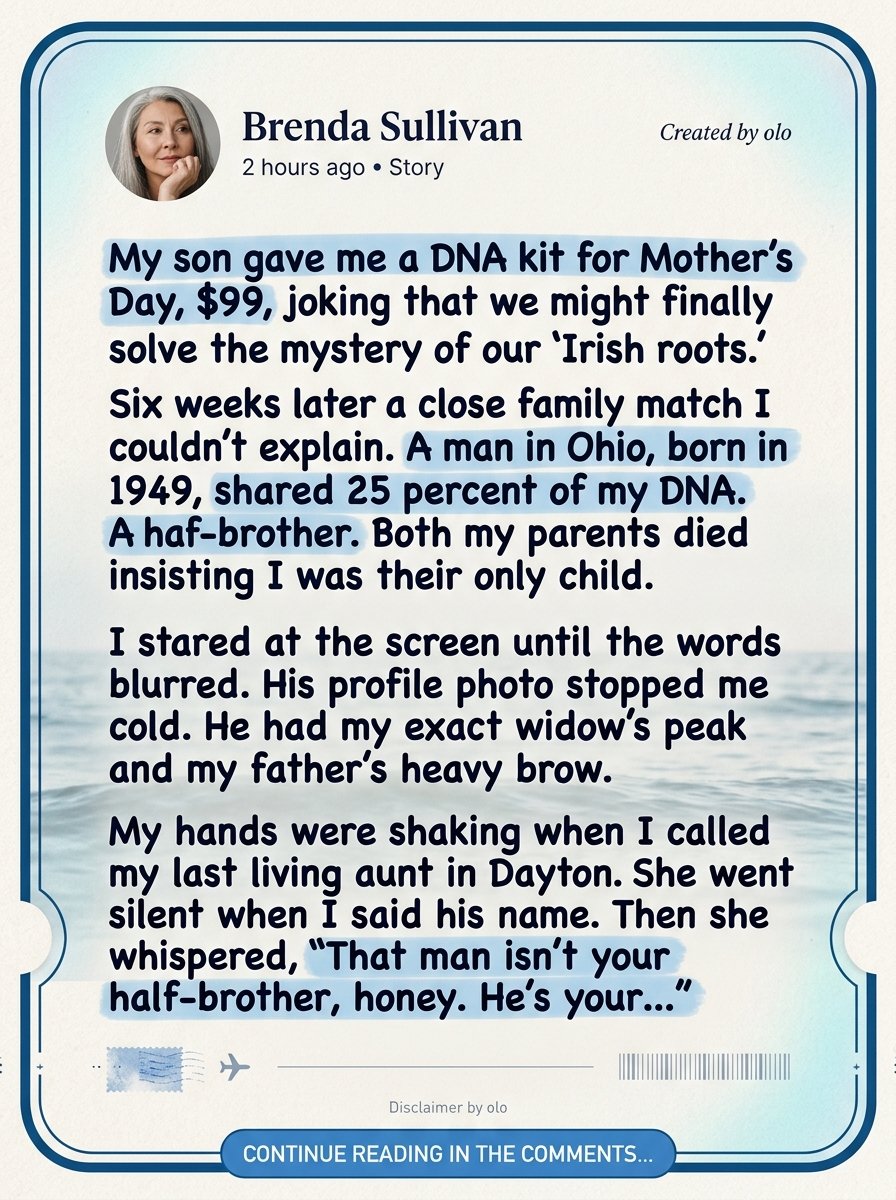
“That man isn’t your half-brother, honey. He’s your…”
My aunt stopped talking. I could hear her breathing through the phone.
“He’s your full brother.”
I laughed because it was the only thing my body knew how to do.
“That’s impossible. My parents told everyone I was an only child. My mother never even mentioned being pregnant before me.”
“Oh, sweetheart,” she whispered. “Your mother was pregnant. Twice.”
I sat down so hard that the chair scraped against the kitchen floor.
“What are you talking about?”
My aunt began to cry.
“In 1949, your mother gave birth to a baby boy. Your father was only twenty-two. They weren’t married yet, and your grandfather threatened to disown your mother if she kept the baby. They told everyone the child had died shortly after birth.”
My stomach twisted.
“But he didn’t die?”
“No. Your mother gave him up for adoption. A family in Ohio took him in. They raised him as their own, and your parents promised never to speak about it again.”
I looked at the DNA results again.
Twenty-five percent.
A half-sibling match, according to the website.
But if my aunt was telling the truth, the man in Ohio wasn’t my half-brother at all.
He was my older brother.
“Why didn’t they tell me?” I whispered.
“Because your father was terrified the truth would destroy the family he’d built. And your mother…” My aunt paused. “Your mother never stopped thinking about that boy. Every year on his birthday, she’d disappear into her bedroom. I thought you knew.”
I didn’t know.
I’d spent my entire life believing my parents had been honest with me. I’d defended them when relatives hinted that our family had secrets. I’d even joked about how strange it was that nobody could explain our Irish ancestry.
Now I wondered how many other stories I’d been told were lies.
My aunt gave me his phone number.
I stared at it for nearly an hour before finally dialing.
A man answered on the third ring.
“Hello?”
His voice was deep, slightly rough, and strangely familiar.
“Hi,” I said, struggling to breathe normally. “My name is Margaret. I recently took a DNA test, and the results say we might be related.”
There was a long silence.
Then he asked, “Were your parents Daniel and Eleanor?”
My heart stopped.
“Yes.”
He exhaled shakily.
“I’ve been looking for them for thirty years.”
I covered my mouth.
He told me his name was Thomas. He’d grown up knowing he was adopted, but his adoptive parents had never been able to tell him much about his birth family. He’d spent years searching for answers, eventually giving up when every lead went cold.
Then, six weeks earlier, he’d received my DNA match.
He’d been waiting for me to contact him.
“I have a question,” he said quietly. “Did our mother ever mention a baby named Thomas?”
“No,” I whispered.
He was silent for a moment.
Then he said something that made my blood run cold.
“That’s strange. Because when my adoptive mother died, I found a letter she’d kept hidden in her Bible. It was from your mother.”
He paused.
“Margaret, the letter said something about a second child.”
A second child?
I gripped the phone.
“What second child?”
Thomas swallowed.
“I think there was someone else. Someone neither of us knows about.”
And then he read me the date written at the bottom of the letter.
It was the date of my birth.
PART 3: THE TRUTH THAT CHANGED EVERYTHING — THE END
I didn’t sleep that night.
At sunrise, I called Thomas back and asked him to read the letter again, slowly, word for word.
He agreed.
The letter was written by my mother in 1951, shortly after I was born. In it, she explained that she’d made the hardest decision of her life when she surrendered her first child.
But the final paragraph was what mattered.
“I have another baby now, a little girl. I look at her every day and wonder whether she will ever know she had a brother. I pray that someday the truth can come out without hurting the people we love.”
I began to cry.
My mother had known.
She’d known I had a brother. She’d held me in her arms while carrying that secret. She’d watched me grow up, graduate, marry, and have a son of my own, never once telling me the truth.
But why?
Thomas had another piece of information.
The letter mentioned a woman named Ruth, my mother’s older sister. My aunt Ruth had died years earlier, and I had always believed she’d been the only relative who knew nothing about our family’s past.
Apparently, she’d been the one who helped arrange the adoption.
Thomas and I agreed to meet.
Two weeks later, he arrived at my house carrying a small cardboard box. He was seventy-seven, with silver hair, kind eyes, and the same distinctive widow’s peak I saw in my own reflection every morning.
When I opened the door, neither of us spoke.
He looked at me for a long moment.
Then he smiled sadly.
“You have Dad’s eyebrows,” he said.
I laughed through my tears.
“And you have Mom’s smile.”
We hugged.
It was awkward at first, two strangers trying to embrace a lifetime of lost birthdays, missed holidays, and family memories we’d never shared.
Then he began to cry.
So did I.
We sat at my kitchen table for hours, exchanging photographs and stories. He showed me pictures of his adoptive parents, the people who had loved him and raised him. I told him about our parents, their habits, their arguments, and the little things I remembered from childhood.
For the first time, I understood that the secret hadn’t just stolen a brother from me.
It had stolen a sister from him.
But there was one question I couldn’t let go.
“Why did our parents insist I was an only child?”
Thomas looked down at the letter.
“I think they were ashamed of what happened. And by the time they realized how much the secret hurt, they’d convinced themselves that telling the truth would only cause more pain.”
It wasn’t a good excuse.
But it was the first explanation that made sense.
Before he left, Thomas handed me a final envelope he’d found inside the box.
It contained a photograph of my mother holding a newborn baby.
On the back, she’d written:
“My little girl, Margaret. And somewhere in this world, her big brother, Thomas. May they find each other someday.”
I pressed the photograph against my chest and cried harder than I had in years.
My mother had wanted us to find each other.
She’d simply never found the courage to make it happen.
In the months that followed, Thomas and I became close. We spoke every Sunday. Our children connected, and my son was thrilled to discover he had an uncle he never knew existed.
Eventually, I stopped asking why my parents had lied.
Not because it didn’t matter, but because I finally understood that the truth was more complicated than the story I’d been told.
My parents had made a terrible choice. They had carried it for decades, believing silence could protect everyone.
Instead, it left two children growing into adults who wondered why something about their lives had always felt incomplete.
I still wish they’d told me.
I wish I’d known Thomas when we were young. I wish I’d heard his voice at family dinners and watched him grow older alongside me.
We can’t recover those years.
But we can decide what happens next.
On my next Mother’s Day, my son asked whether I regretted taking the DNA test.
I looked at the photograph of Thomas and me standing together in my garden.
“No,” I told him. “Not for one second.”
That little $99 gift had uncovered a secret that had survived more than seven decades.
It had forced me to question everything I thought I knew about my family.
But it had also given me something I never expected to find at my age.
A brother.
And I learned something I wish my parents had understood:
A secret may protect a family from an uncomfortable truth for a while, but it can never give back the years that truth takes away.
Sometimes, the greatest gift we can leave the next generation isn’t a perfect family story.
It’s the courage to tell the real one.