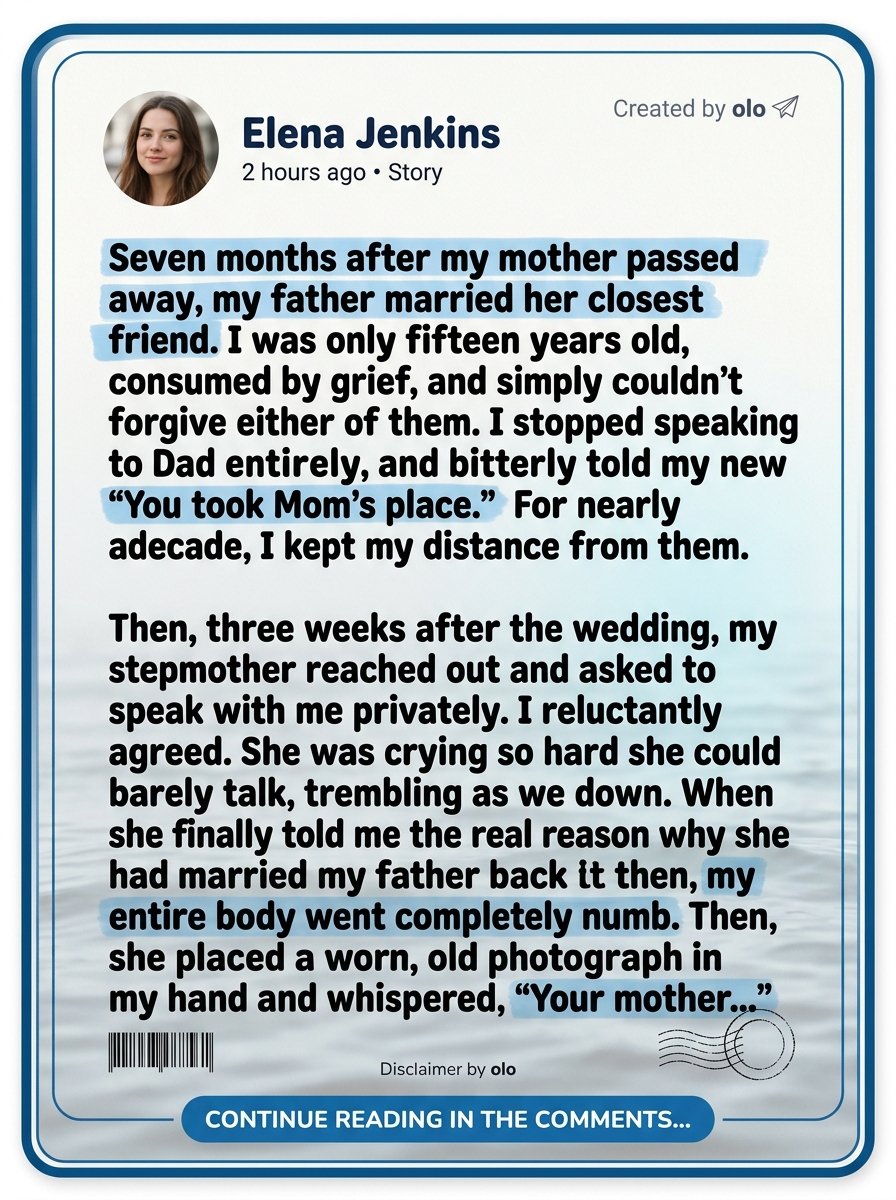
 I stared at the photograph in my hand. It showed my mother sitting beside my stepmother in a hospital room. They were holding hands, both smiling through tears.
“That’s impossible,” I said. “Mom never told me anything.”
My stepmother shook her head. “She didn’t want you to know how sick she really was. She was afraid you’d spend your last months with her worrying instead of being a teenager.”
I felt my throat tighten.
“She knew she wasn’t going to survive,” my stepmother continued. “And she knew your father would fall apart after she was gone. She was worried about you both.”
I shook my head angrily. “So you married him out of pity?”
“No!” she cried. “I married him because your mother asked me to take care of you. But I waited. I tried to give your father time. We never planned to get married so soon.”
“Then why did you?”
She looked down at the photograph.
“Because your father found your mother’s final letter. He read it alone, and the next morning, he asked me to marry him. I didn’t know what the letter said until after the wedding.”
My hands began to tremble.
“What letter?”
She reached into her purse and pulled out a folded piece of paper.
“Your mother wrote it for you.”
I recognized her handwriting immediately.
And when I read the first sentence, my knees nearly gave way.
My sweet boy, if you’re reading this, please don’t hate the two people who love you most.
Part 3
I couldn’t breathe.
I sat down and read the letter again, hoping I’d misunderstood it.
My mother wrote that she’d known my stepmother for years. She trusted her more than anyone else in the world. During her final months, when she was too weak to get out of bed, my stepmother had been the one helping her eat, brushing her hair, and staying awake beside her when the pain became unbearable.
Then I reached the part that broke me.
Your father has always loved me, but I know him. When I am gone, he will pretend to be strong until the day he breaks. Please don’t let him disappear into his grief.
And if my friend ever becomes part of your family, please don’t think she came to replace me. Nobody can replace your mother. I only ask that you let her love you in her own way.
Tears blurred the words.
I looked at my stepmother. “Why didn’t you tell me this before?”
She wiped her face with trembling hands.
“Because I knew how much you hated me. I thought if I showed you the letter, you’d believe I was using your mother’s death to earn your forgiveness. I wanted you to accept me because of who I am, not because of a promise made to a dying woman.”
For the first time in years, I noticed how tired she looked.
She hadn’t tried to take my mother’s photographs down. She hadn’t changed the recipes my mother had written in her notebook. She’d even kept Mom’s favorite mug in the kitchen cupboard.
All those years, I’d thought those things were signs of guilt.
Now I wondered if they were signs of love.
“Does Dad know I have this letter?” I asked.
She shook her head.
“He gave it to me after the wedding. He said he couldn’t bear to read it again.”
I folded the letter carefully and held it against my chest.
Then I asked the question I’d been too afraid to ask for nearly a decade.
“Did Mom really know she was going to die?”
My stepmother took my hand.
“Yes, sweetheart. And she spent her final days making sure you would never be alone.”
That was when I finally broke down and cried.
Not because I hated my stepmother.
But because I’d spent so many years hating someone who had been trying to keep a promise to my mother.
The End
That evening, I went to my father’s room.
He was sitting on the edge of his bed, staring at an old photograph of Mom.
When he saw me, he quickly wiped his eyes.
“What’s wrong?” he asked.
I sat beside him and placed the letter between us.
“I read it, Dad.”
He stared at the paper. His lips trembled, but he didn’t say anything.
For a long moment, we simply sat there, two people who had lost the same person and somehow lost each other, too.
Then I whispered, “I’m sorry I stopped talking to you.”
He covered his face and began to cry.
“I thought you hated me,” he said. “I wanted to explain, but every time I looked at you, I saw how much you were hurting. I didn’t know how to make it better.”
I hugged him.
For the first time in nearly ten years, my father held me like he used to when I was a child.
A few minutes later, my stepmother appeared at the doorway. She started to turn away, giving us privacy.
“Wait,” I said.
She stopped.
I stood up, walked over to her, and hugged her, too.
She froze in surprise before wrapping her arms around me.
“I can’t call you Mom,” I whispered.
“I would never ask you to,” she replied.
“But maybe I can stop treating you like an enemy.”
She cried against my shoulder.
That night, we sat together at the kitchen table. My father told stories about my mother, and my stepmother filled in the details I’d never known. For the first time, I heard them laugh about her without feeling as though they were betraying her memory.
Years later, I understood something I couldn’t understand at fifteen.
Love doesn’t always arrive in the way we expect. And sometimes, the person we blame for our pain is carrying a promise we know nothing about.
My stepmother never replaced my mother.
She didn’t have to.
She simply helped keep my mother’s love alive in a house that had almost forgotten how to feel like a home.
And every year on my mother’s birthday, the three of us place that old photograph on the table.
On the back, in my mother’s handwriting, are seven simple words:
Please take care of each other for me.
We finally did.