I couldn’t stop staring at the balance.
$82,600.
Mama had spent her final years clipping coupons, turning off lights, and watering dying plants with leftover dishwater. Yet somehow, she’d left behind an account worth more money than I’d ever seen in my life.
And she’d hidden the card inside a hat my sister had called junk.
I returned to the choir program. On the back, beneath Mama’s message about Psalm 27, I noticed a second line I’d missed.
“Ask for Mr. Bennett. He knows what your sister doesn’t.”
The next morning, I visited the bank.
Mr. Bennett was an older man with silver hair and a tired expression. When I showed him the card and Mama’s note, he locked his office door.
“Your mother asked me to wait until you came,” he said.
“Wait for what?”
He opened a drawer and removed a sealed envelope.
“Your mother didn’t trust that everyone in her family wanted what was best for you.”
Inside was a copy of a trust agreement, dated twenty-seven years earlier. Mama had been depositing money into the account for decades, using her maiden name. The funds came from an inheritance she’d received from her own mother.
But the trust had one unusual condition.
The money couldn’t be released until the beneficiary discovered the account without anyone directing them to it.
I had found it because I’d taken the hat home.
Mr. Bennett explained that the account was mine, subject to the trust’s terms and the bank’s verification process.
Then he handed me another document.
It was a request to transfer the entire balance, submitted three weeks before Mama died.
The signature belonged to Darlene.
My sister had tried to claim the money before Mama was even buried.
“Did she get it?” I asked.
“No,” he replied. “Your mother had placed restrictions on the account. The request was rejected.”
I felt sick.
Darlene had inherited the house, which sold for $365,000. Why would she risk everything to take the money Mama had left me?
I drove straight to her apartment.
She opened the door wearing the same gold necklace Mama had given her years ago.
“What do you want?” she asked.
I held up the bank document.
Her face went white.
“You had no right to touch that account,” I said.
She glanced at the paper and then at me.
“You don’t understand.”
“Then explain it.”
She began to cry.
“Mama owed me that money.”
“Owed you? For what?”
Darlene wiped her face and whispered something that made my blood run cold.
“Because I was the one who paid her bills during the last two years. I was the one who took her to appointments. I was the one who stayed when she couldn’t remember my name.”
I stared at her.
“Then why didn’t you tell me?”
“Because Mama made me promise not to.”
She walked to a cabinet and pulled out a small black notebook.
Inside were dates, receipts, and handwritten notes documenting every payment she’d made for Mama.
But on the final page was something else.
A message in Mama’s handwriting.
“Darlene, if you are reading this, it means you have forgotten the difference between being owed money and being owed love.”
My sister collapsed into a chair.
And for the first time, I realized that the story I’d been telling myself about Mama’s final days was incomplete.
But the notebook wasn’t the only thing Darlene had kept.
From beneath a stack of papers, she pulled out an old photograph of Mama standing beside a man I hadn’t seen since childhood.
My father.
The man Darlene had always insisted abandoned us.
On the back, Mama had written:
“He tried to come home. Ask Darlene why he never did.”
I looked at my sister.
She couldn’t meet my eyes.
“Tell me what happened,” I said.
She shook her head.
“You’re not ready.”
“Then make me ready.”
She took a deep breath.
And finally began to speak.
PART 3: The Secret That Changed Everything
“Dad didn’t abandon us,” Darlene whispered.
I felt the room tilt.
“What?”
“He tried to come back. More than once.”
I gripped the edge of the table.
“You told me he left because he didn’t want us.”
“I know.”
“Why would you lie about something like that?”
Darlene stared at the photograph.
“Because I was seventeen, and I made a terrible mistake.”
She explained that our father had discovered she’d secretly borrowed money from Mama’s savings account. She had intended to replace it before anyone noticed, but the money was gone.
When he confronted her, she panicked.
She told Mama that he had been taking money from the household and threatened to leave if anyone questioned her.
Our father denied it. The argument grew so bitter that he moved out temporarily.
But Darlene didn’t stop there.
She intercepted his letters, hid his phone messages, and convinced Mama that he wanted nothing more to do with us.
By the time the truth began to surface, years had passed.
Mama eventually learned what Darlene had done, but she couldn’t bring herself to expose her daughter. She kept the letters and photographs, hoping one day the family would reconcile.
“He died six years ago,” Darlene whispered. “I found out from an old neighbor. I never told Mama because I was afraid she’d hate me.”
I sat in silence.
For years, I’d imagined my father as a man who had chosen freedom over his children.
Instead, he’d been a man whose attempts to return had been hidden from us.
I looked at Darlene.
“Did Mama forgive you?”
She shook her head slowly.
“She said she loved me. But she never said she’d forgiven me.”
For the first time, I understood why Mama had left the hat to me.
She hadn’t been giving me junk.
She’d been giving me a way to uncover the truth.
The bank account was only part of the inheritance. The real gift was the chance to learn what had happened before it was too late.
I returned home and opened Mama’s red Bible again.
This time, I read Psalm 27 from beginning to end.
A second envelope slipped from the back cover. It contained a letter addressed to both of us.
“My girls, I have made mistakes by staying silent. I thought I was protecting this family, but silence only gave our pain more time to grow.
“The house belongs to Darlene. The account belongs to the person named in the trust. Neither gift measures how much I loved you.
“If you have found this letter, then at least one of you has finally started asking questions. Keep asking them. Even when the answers hurt.”
I read the letter to Darlene the following afternoon.
She cried quietly, without defending herself.
“I can’t change what I did,” she said.
“No,” I replied. “But you can stop lying about it.”
The bank handled the account according to the trust documents, and Darlene’s attempted transfer was addressed through the proper process. I didn’t give her the money simply because she was my sister, and I didn’t let the inheritance decide what our relationship would become.
Rebuilding trust took time.
Some days, we could talk about Mama without arguing. Other days, the past sat between us like another person at the table.
Eventually, we visited our father’s grave together.
I placed the old photograph beneath a bouquet of white flowers.
Darlene stood beside me, trembling.
“I’m sorry, Dad,” she whispered.
I didn’t know whether he could hear her.
But I knew I could.
Before we left, I took the blue church hat from its box and placed it beside Mama’s photograph at home.
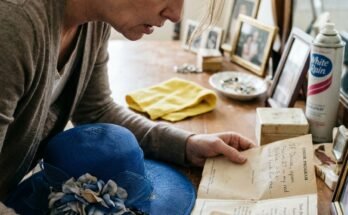
The brim was still split. The fabric was faded, and a faint trace of White Rain hairspray remained.
For months, I’d thought the hat had brought me money.
Now I understood that it had brought me something far more important.
It had forced me to question the stories I’d accepted, confront the person I’d trusted, and discover the truth about the father I’d mourned without ever really knowing.
Mama hadn’t left behind a perfect family.
She’d left behind a chance to make a different one.
And I finally understood the last words she’d written on the choir program:
“Sometimes, the things we call junk are the things that save us.”
I kept the hat for the rest of my life.
Not because it was valuable.
But because it reminded me that the truth may arrive late, wrapped in old paper, hidden beneath years of silence.
And when it finally finds you, you have a choice.
You can bury it again.
Or you can let it set you free.