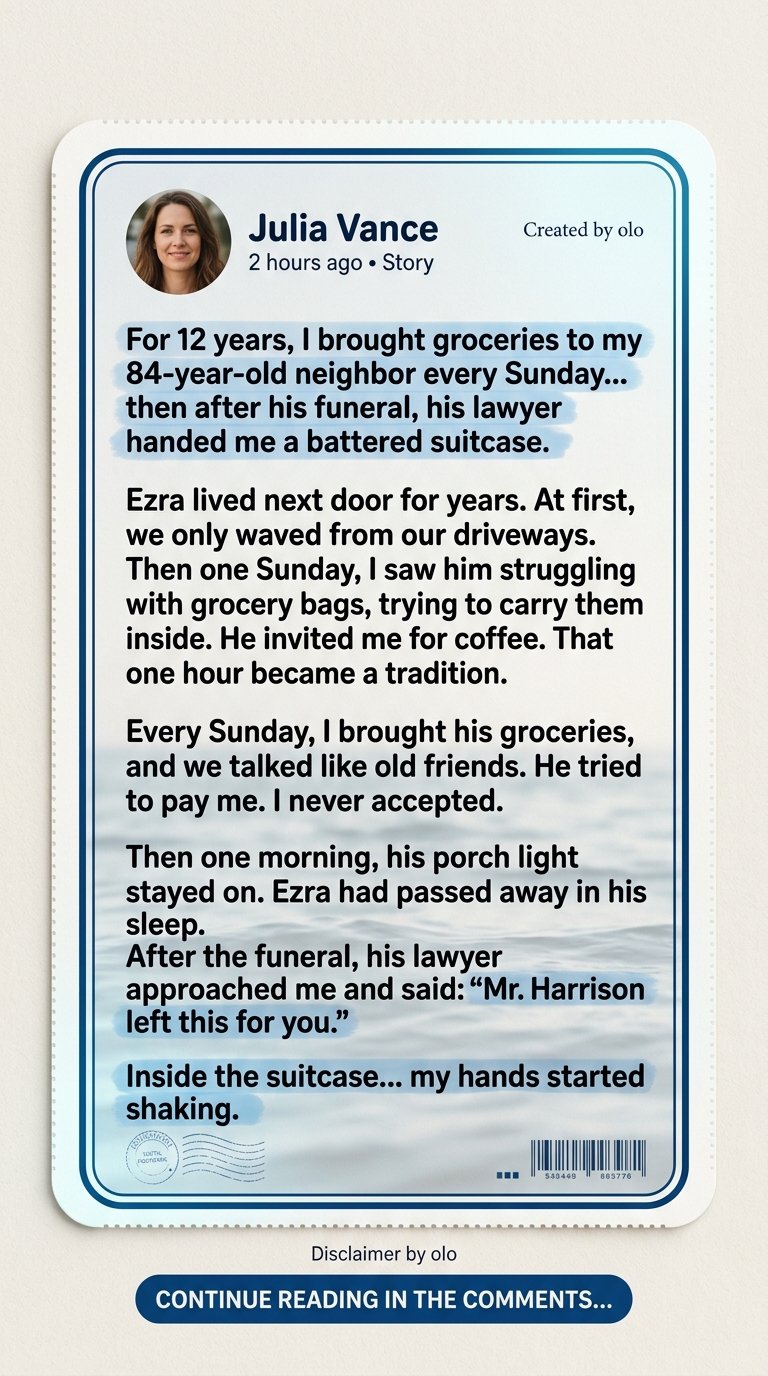
For more than a decade, my Sunday mornings followed the exact same routine. Before doing anything else, I’d stop by the neighborhood grocery store to pick up a familiar list: fresh milk, oatmeal, whole wheat bread, canned peaches, black coffee, and the morning newspaper. Then I’d carry everything to the modest white house next door.
That’s where Ezra Harrison lived.
When we first met, he was already eighty-four years old. We weren’t close at the beginning—we simply greeted each other with a friendly wave whenever we crossed paths. Everything changed one rainy weekend when I noticed him struggling to carry heavy grocery bags up his front steps. I hurried over to help, and after we put everything away, he invited me inside for a cup of coffee.
That single cup of coffee lasted nearly two hours.
From that day forward, Sunday mornings became our tradition. We’d sit together talking about baseball, history, old memories, and sometimes absolutely nothing at all. Ezra shared stories about serving in the Navy, falling in love with his wife Margaret, losing her after many happy years together, and learning just how quiet life could become after the person you love is gone.
Every week he tried to pay me twenty dollars for bringing his groceries.
Every week I smiled and pushed the money back.
When he asked why I refused, I simply answered, “Because I’d hope someone would do the same for my father someday.”
He never argued after that.
The years quietly slipped by. My children grew up knowing him as “Mr. Ezra,” the kind neighbor who always had peppermint candy in his pocket and enough terrible jokes to make everyone laugh. He celebrated every one of their birthdays, and they never forgot his.
But time eventually caught up with him. His steps slowed, his hands trembled more each year, and his hearing faded. Still, every Sunday, he’d have a fresh pot of coffee waiting before I even knocked on the door.
Then one Sunday, everything felt different.
His porch light was still glowing long after sunrise.
I knocked once.
No answer.
I knocked again, louder this time.
Silence.
With a growing sense of dread, I called the police. They entered through the back door, and a few minutes later an officer stepped outside with a gentle expression.
Ezra had peacefully passed away in his favorite recliner during the night.
His funeral was quiet. Only a few distant relatives attended, while most of the guests were neighbors whose lives he had quietly touched over the years.
As people began leaving, a man in a gray suit introduced himself.
“I’m Mr. Lawson, Mr. Harrison’s attorney.”
He placed an old, weathered suitcase into my hands.
“Ezra wanted you to have this.”
Certain there had been a mistake, I tried to refuse.
“There isn’t,” the attorney replied with a smile. “He was very clear.”
That evening, my wife and I placed the worn suitcase on our kitchen table. Its cracked leather and faded brass latches showed decades of use. When I finally opened it, I found dozens of carefully organized envelopes, each marked with a different Sunday date stretching back twelve years.
Resting on top was one envelope addressed simply:
To Daniel.
Inside was Ezra’s final letter.
He thanked me—not for the groceries, nor for helping around the house—but for treating him like he still mattered.
He wrote that loneliness doesn’t arrive all at once. Instead, it quietly steals pieces of a person’s heart every day, and every Sunday visit helped him reclaim one of those pieces.
By the time I finished reading, I could barely hold back my tears.
As I continued searching through the suitcase, I realized every dated envelope contained twenty dollars—the exact payment he had tried to give me every single week.
He had never spent it.
He had saved every dollar.
More than six hundred envelopes sat neatly inside.
Then I discovered a small metal box containing a bank passbook.
The account balance left me speechless.
More than $275,000.
Another letter explained the story behind the money. After Margaret passed away, Ezra had sold family farmland that unexpectedly became extremely valuable when nearby land was purchased for commercial development. Instead of spending the proceeds, he invested them wisely and later created a trust.
To my complete surprise, I had been named the beneficiary.
There was only one request.
A portion of the inheritance had to be used to help elderly people who were living alone.
Weeks passed before I truly understood the responsibility Ezra had placed in my hands. Eventually, my wife and I used part of the money to create The Sunday Table, a volunteer program that connected families with lonely senior citizens throughout our community.
The program began with only six volunteers.
Within a year, more than one hundred people had joined.
They delivered groceries, shared meals, celebrated birthdays, listened to life stories, drove seniors to appointments, and most importantly, reminded them that they were not forgotten.
Five years later, the project had spread into neighboring communities, bringing companionship to thousands of older adults.
Many volunteers admitted they had received far more than they had ever given.
Even today, every Sunday morning begins with one familiar stop.
I visit Ezra’s grave carrying a fresh cup of coffee.
I sit quietly for a while and tell him how his kindness continues to inspire strangers to care for one another.
Because in the end, the greatest inheritance he left behind wasn’t the money inside an old suitcase.
It was the reminder that giving someone your time, your friendship, and your presence can become the most valuable gift of all.
As I leave each week, I smile and whisper the same words:
“See you next Sunday, my friend.”
Sometimes the smallest act of kindness, repeated over many years, creates a legacy that reaches far beyond one lifetime.