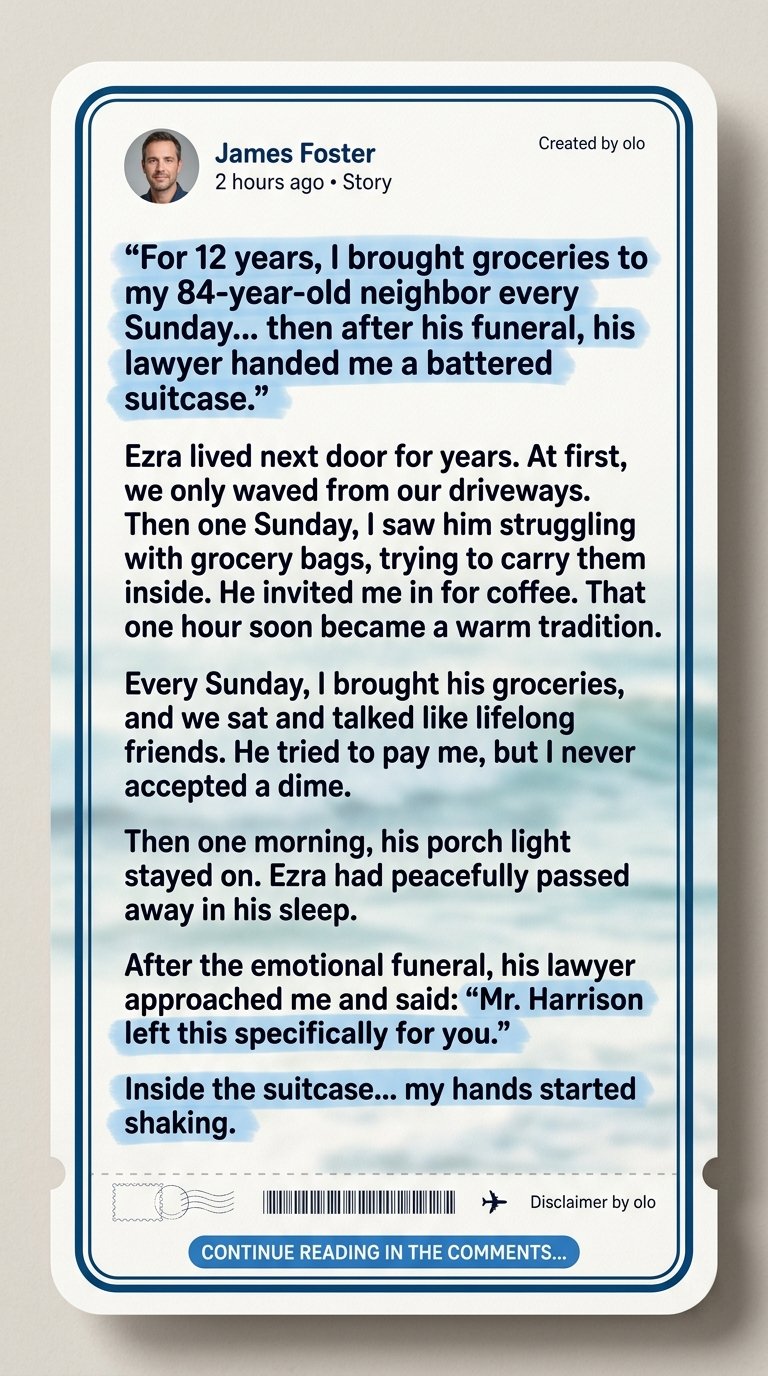
For twelve years, my Sundays followed a simple tradition that slowly became one of the most meaningful parts of my life.
Every week, after stopping at the grocery store, I would pick up the same items: a loaf of bread, fresh milk, oatmeal, canned peaches, black coffee, and the newspaper. Then I would walk next door to a small white house where my elderly neighbor, Ezra Harrison, lived alone.
When I first met Ezra, he was already eighty-four years old.
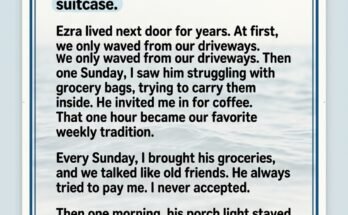
At the beginning, we were just neighbors who exchanged polite smiles and friendly waves. But one rainy Sunday morning, everything changed. I saw Ezra struggling with several heavy grocery bags, trying to make his way up the porch steps. Without thinking, I rushed over to help him.
“You shouldn’t be carrying all this by yourself,” I told him.
He laughed softly.
“At my age, everything feels heavier than it used to.”
After helping him put the groceries away, Ezra asked if I wanted to stay for a cup of coffee.
I expected ten minutes.
I stayed for almost two hours.
That conversation became the beginning of a friendship neither of us knew we needed.
From that day forward, Sunday mornings belonged to Ezra and me.
We talked about everything—baseball, history, old movies, childhood memories, and sometimes absolutely nothing. He shared stories about his years serving in the Navy, the day he met his wife Margaret at a county fair, and the beautiful life they built together before cancer took her away.
After Margaret passed, Ezra admitted the silence inside his home became harder than he ever expected.
But every Sunday, for a few hours, he wasn’t alone.
Every week after I delivered his groceries, Ezra would reach into his wallet and offer me twenty dollars.
Every week, I refused.
“You don’t owe me anything,” I would say.
He would look at me and ask, “Then why do you keep coming?”
My answer was always the same.
“Because if my father ever needed someone, I would hope a person would do this for him.”
Those words always made him smile.
As the years passed, Ezra became more than just a neighbor.
He became family.
My children grew up knowing him as “Mr. Ezra,” the kind old man who always carried peppermint candies in his pocket and told jokes that were so bad they somehow became funny. He remembered every birthday, celebrated every achievement, and always made time for the people around him.
But age slowly changed him.
His steps became slower.
His hands became less steady.
His hearing wasn’t what it used to be.
Still, every Sunday morning, the smell of fresh coffee welcomed me before I even knocked.
Until one Sunday…
Something felt wrong.
The porch light was still on.
The morning was already bright, but Ezra hadn’t opened the door.
I knocked.
Nothing.
I knocked again.
Still nothing.
A cold feeling settled over me.
I called the police.
The officers entered through the back door while I waited outside, hoping I was wrong.
A few minutes later, one of them walked toward me.
His expression told me everything.
“I’m sorry.”
Ezra had passed away peacefully in his favorite chair during the night.
The funeral was small and quiet. A few relatives attended, but most of the people there were neighbors—people whose lives Ezra had touched in ways he probably never realized.
As everyone began leaving, a man in a gray suit approached me.
“Daniel Carter?”
“Yes.”
“I’m Mr. Lawson. Ezra Harrison’s attorney.”
Then he handed me an old leather suitcase.
“Ezra left this for you.”
I stared at it, confused.
“There must be some mistake.”
The attorney shook his head.
“No mistake. Ezra was very clear about who should receive it.”
That evening, my wife and I placed the suitcase on our kitchen table.
It was worn and faded, with cracked leather and old brass locks. It looked like something that had carried decades of memories.
Slowly, I opened it.
Inside were hundreds of envelopes.
Each one had a date written on it.
The oldest was from twelve years earlier.
The newest was dated only a few weeks before Ezra passed away.
On top of everything was one final envelope.
It simply said:
To Daniel.
My hands trembled as I opened the letter.
Ezra had written:
“Daniel,
If you are reading this, then I am no longer sitting across from you drinking coffee every Sunday.
Before anything else, I want to say thank you.
Not for bringing groceries.
Not for helping me around the house.
Thank you for reminding me that I still mattered.
Loneliness doesn’t disappear overnight. It slowly takes pieces of a person’s happiness away. Every Sunday you came, you gave me one of those pieces back.”
I had to stop reading because my eyes filled with tears.
The letter continued.
“I know you always refused my twenty dollars. But I never forgot your kindness. I found another way to give it back.”
I looked inside the suitcase again.
That’s when I discovered what was inside every envelope.
Twenty dollars.
The exact amount Ezra had offered me every single Sunday.
He had saved every single one.
More than six hundred envelopes sat inside that suitcase.
Then, underneath them, I found a small metal box.
Inside was a bank passbook.
The balance made me freeze.
More than $275,000.
A second letter explained everything.
After Margaret died, Ezra had sold a piece of family farmland that later became extremely valuable because of nearby development. Instead of spending the money, he invested it carefully and created a trust with the help of his attorney.
And somehow…
He had chosen me as the beneficiary.
But there was one condition.
The money was not meant to simply change my life.
It was meant to change someone else’s.
Ezra wanted part of the inheritance used to help elderly people who were living alone.
Because he knew what loneliness felt like.
Because he knew someone else might be waiting for a Sunday visitor.
For weeks, I thought about his final request.
Eventually, my wife and I decided to honor Ezra’s wish.
We used part of the money to create The Sunday Table, a community program connecting volunteers with elderly neighbors who needed companionship.
At first, only six people joined.
Within one year, more than one hundred volunteers became part of the program.
They delivered groceries.
Shared meals.
Listened to stories.
Celebrated birthdays.
Helped with appointments.
But most importantly…
They showed up.
Five years later, The Sunday Table expanded into several nearby communities. Thousands of seniors who once felt forgotten now had people checking on them every week.
Many volunteers said they started the program to help others, but ended up receiving just as much love and wisdom in return.
Even today, my Sundays begin the same way.
Before visiting new members of the program, I stop by Ezra’s grave with a fresh cup of coffee.
I sit beside him and tell him about the lives that continue to change because of one friendship that started with two grocery bags and a simple invitation for coffee.
Looking back, I understand that Ezra’s greatest gift was never the money inside that suitcase.
It was the lesson he left behind.
A person’s greatest impact isn’t measured by what they leave behind.
It’s measured by the people who become better because they were there.
Every week, before I leave his grave, I smile and whisper:
“See you next Sunday, my friend.”
Because sometimes the smallest acts of kindness, repeated over time, become the greatest legacy anyone can leave behind.