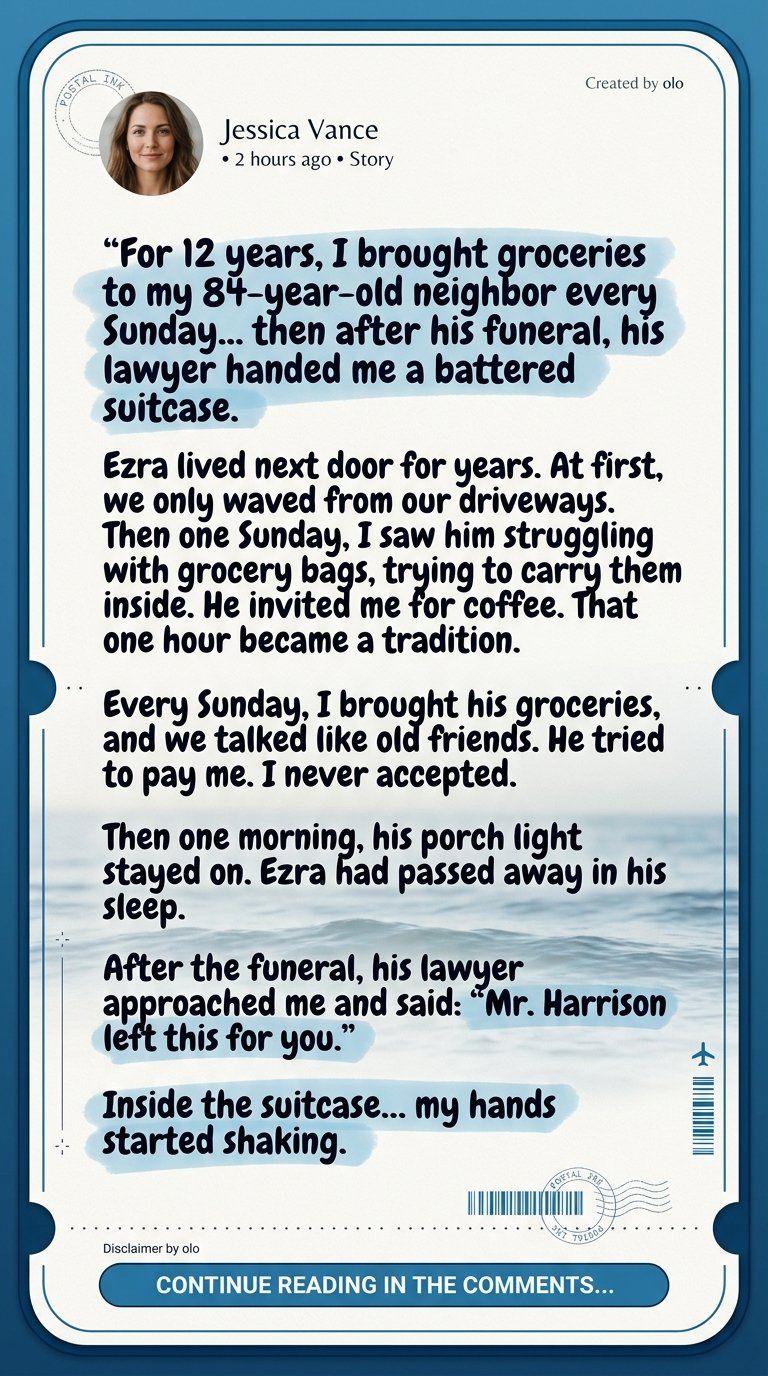
For twelve straight years, my Sundays always began the same way. Before heading home with my own groceries, I’d stop at the local market and buy a familiar collection of items—bread, oatmeal, fresh milk, canned peaches, black coffee, and the daily newspaper. Then I’d walk next door and deliver everything to my elderly neighbor, Ezra Harrison.
When we first met, Ezra was already eighty-four. At first, our relationship was nothing more than friendly waves from across the driveway. That changed one rainy afternoon when I spotted him struggling to carry heavy grocery bags into his house. I hurried over to help, and after we finished unloading everything, he invited me inside for coffee.
That afternoon became the beginning of an unexpected friendship.
From then on, every Sunday belonged to us. We’d spend hours talking about his younger days, military service, baseball, family memories, and the wife he had loved so deeply. Margaret had passed away years earlier, and although Ezra rarely complained, it was obvious the silence inside his home had become his constant companion. Every week he insisted on paying me twenty dollars for bringing his groceries, and every week I politely refused. When he asked why, I always gave the same answer: “Because I hope someone would show my father this same kindness if he ever needed it.” He never tried to convince me otherwise after hearing those words.
The years quietly slipped away. My children came to adore “Mr. Ezra,” who always welcomed them with peppermints, warm smiles, and stories that somehow became more entertaining every time he told them. But age slowly began to take its toll. His hands became less steady, his hearing faded, and walking across the porch required more effort than before. Even so, every Sunday morning, the coffee was already brewing before I reached his front door.
Then came the Sunday that changed everything.
His porch light was still shining well after daylight. I knocked several times, but no one answered. My concern quickly turned into fear, so I called the police. After entering through the back of the house, an officer returned a few minutes later with heartbreaking news. Ezra had peacefully passed away in his recliner during the night.
The funeral reflected the quiet life he had lived. Only a few relatives attended, but many neighbors came to pay their respects. As the service ended, a lawyer approached me carrying an old leather suitcase that looked as though it had traveled through decades of memories.
“Mr. Harrison wanted you to have this,” he said.
Certain there had been a misunderstanding, I hesitated. The attorney simply smiled and assured me Ezra had left very clear instructions.
Later that evening, my wife and I carefully opened the weathered suitcase. Inside were hundreds of envelopes arranged in perfect order. Every one of them was labeled with a Sunday date spanning the previous twelve years.
Sitting neatly on top was a single envelope addressed only to me.
Inside, Ezra thanked me—not for delivering groceries or helping around the house, but for making him feel seen during the loneliest years of his life. He wrote that loneliness slowly steals pieces of a person’s spirit, and that every Sunday visit helped him recover a little of what he had lost.
By the end of the letter, tears blurred my vision.
Curious, I opened the dated envelopes one by one.
Each contained twenty dollars.
It was the exact amount he had offered me every single week.
Instead of spending it, he had carefully saved every payment I refused to accept.
There were more than six hundred envelopes.
Hidden beneath them was a small metal box containing a bank passbook. When I saw the balance, I froze.
The account held more than $275,000.
Another letter explained everything. Years after Margaret’s passing, Ezra had sold family farmland that dramatically increased in value after nearby commercial development. Rather than spending the money, he invested it wisely and eventually established a trust. To my complete surprise, I had been chosen as the beneficiary.
There was only one condition.
Part of the inheritance had to be dedicated to helping elderly people who lived alone.
The request stayed with me for weeks. Eventually, my wife and I used part of the money to create The Sunday Table, a community volunteer program that matched caring families with isolated senior citizens. It started with just six volunteers but quickly grew beyond anything we imagined. Within a year, more than one hundred people were delivering groceries, sharing meals, celebrating birthdays, offering transportation, and most importantly, giving lonely seniors something many had gone without for years—companionship.
Five years later, the organization had expanded into neighboring communities, touching thousands of lives. Many volunteers admitted they received just as much joy from the friendships as the seniors they served.
To this day, my Sundays still begin with one important visit.
Before meeting with volunteers, I stop at Ezra’s grave carrying a fresh cup of coffee. I sit beside him for a few quiet moments and tell him about the people whose lives continue to change because of his generosity and vision.
Over time, I’ve realized the true value of the old suitcase had nothing to do with the money it contained.
Its greatest treasure was the lesson Ezra left behind—that kindness doesn’t require wealth, only consistency, compassion, and the willingness to show up for someone who feels forgotten.
As I walk away each week, I always smile and quietly say the same words.
“See you next Sunday, my friend.”
Some legacies are measured in dollars.
The greatest ones are measured in the lives they continue to change long after we’re gone.