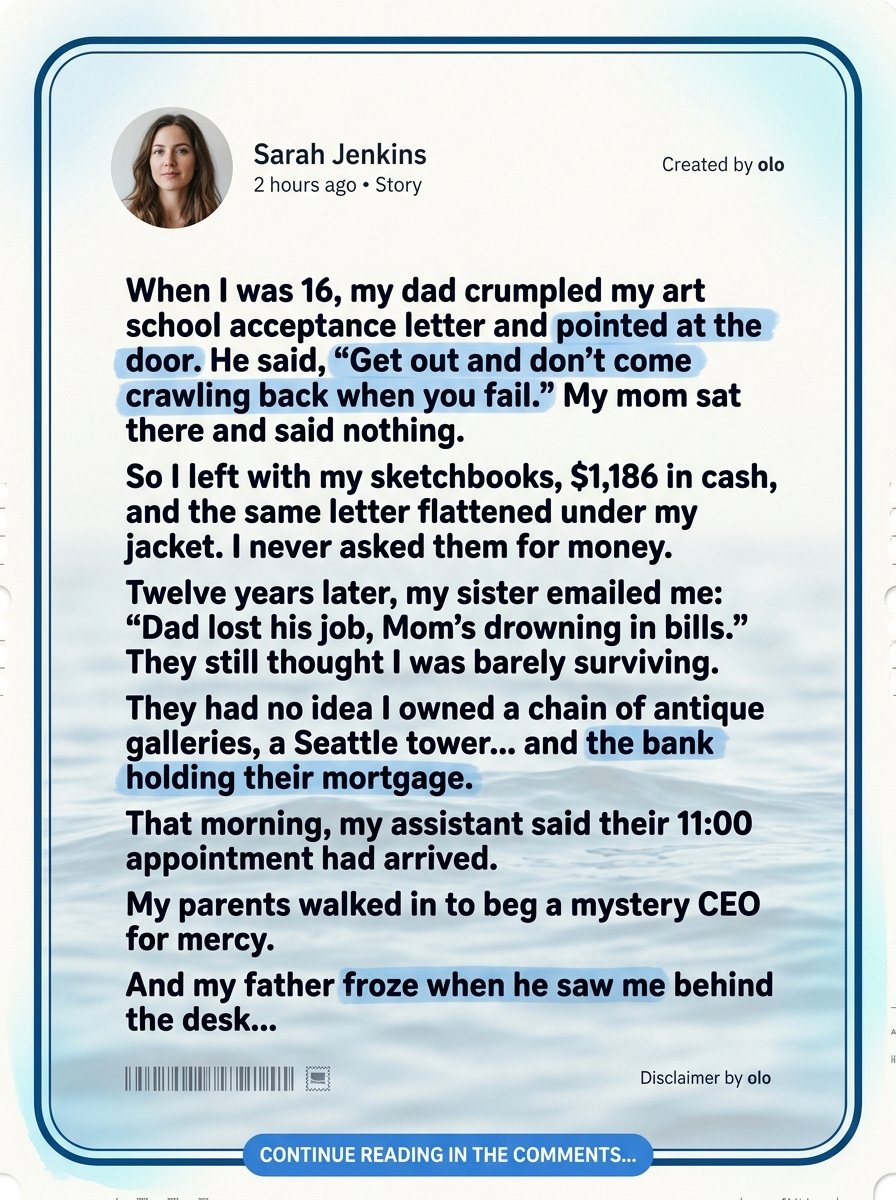
My father stared at me as if he were looking at a ghost.
“Emily?” he whispered.
I closed the folder on my desk. “Good morning. You have an appointment with the CEO of Northstar Holdings. Please, have a seat.”
My mother clutched her handbag. My father didn’t move.
“You own this company?” he finally asked.
“I do.”
He looked around the office, at the floor-to-ceiling windows overlooking Seattle, the original paintings on the walls, and the assistant standing beside my desk.
Then he looked back at me.
“How?”
I almost laughed.
Twelve years earlier, I’d left their house with $1,186, a handful of sketchbooks, and an acceptance letter to an art school they’d told me I would never attend.
I slept in a friend’s basement that first month. I worked mornings at a coffee shop, evenings cleaning an office building, and spent whatever time remained drawing in the margins of old newspapers.
I couldn’t afford the art school tuition, so I deferred my admission and took community college classes instead.
One afternoon, I found a battered antique painting at a neighborhood estate sale. Everyone else saw a cracked frame and faded colors. I saw a beautiful piece of art buried beneath years of neglect.
I bought it with almost all my savings.
After restoring it, I sold it for nearly eight times what I’d paid.
That single sale changed my life.
I studied antique restoration, learned the business, and eventually opened a tiny gallery. One gallery became three. Three became a chain. Then I began acquiring historic properties, restoring neglected buildings, and turning them into thriving commercial spaces.
I didn’t become successful overnight.
I became successful one exhausted night, one rejected loan application, one repaired painting, and one terrifying risk at a time.
And through all of it, I never asked my parents for a dollar.
My father finally sat down.
“We need your help,” he said.
There it was.
Not I’m sorry.
Not We were wrong.
Just another request.
I folded my hands on the desk.
“Tell me about the mortgage.”
My mother began crying.
“We fell behind after your father lost his job. The bank says they’re moving forward with foreclosure. We thought if we could speak to the owner, perhaps we could arrange a little more time.”
I glanced at the file my assistant had prepared.
The mortgage had been acquired by one of our subsidiaries as part of a larger portfolio of distressed loans. My parents had no idea who ultimately owned it.
I knew their payment history. I knew the outstanding balance. I knew how close they were to losing the house.
But I also knew something they didn’t.
I had been given the chance to save them from a financial disaster.
The question was whether saving them meant letting them back into my life.
“Dad,” I asked quietly, “do you remember the day you threw me out?”
His face tightened.
“That was a long time ago.”
“I remember every word.”
My mother stared at the floor.
I continued, “You told me I’d fail. You told me not to come crawling back. And Mom, you sat there and watched.”
My father’s jaw clenched.
“We were trying to teach you to be realistic.”
“No,” I said. “You were trying to make me afraid of being myself.”
The room went silent.
Then my father said the one thing I never expected to hear.
“Your sister told us you were barely getting by. We thought you might be able to understand what we’re going through.”
I looked at him for a long moment.
“You still thought I was a failure.”
He had no answer.
And that was when I realized the real reason they had come to see me.
They hadn’t come because they finally believed in me.
They had come because they needed something.
But before I could respond, my assistant stepped forward and placed a sealed envelope on my desk.
“There’s one more thing you should see,” she said.
It was a letter from my sister.
And it changed everything.
Part 3: The Letter That Revealed the Truth
I opened the envelope.
Inside was a printed copy of an email my sister, Sarah, had sent to my assistant three days earlier.
Please don’t tell my parents I contacted you.
My father is proud, and my mother is afraid of him. They believe Emily is struggling because that’s what Dad has told everyone for years.
The truth is, he has been telling people she abandoned her family because she became selfish and obsessed with money.
I stopped reading.
My father leaned forward.
“What is that?”
I kept my eyes on the page.
Sarah’s email continued.
When Emily left home, I was only twelve. I watched Dad tear up her acceptance letter. I watched Mom cry after Emily was gone, but she never admitted she should have stopped him.
I’ve spent years wishing I’d been brave enough to defend my sister.
Please tell Emily that I’m sorry.
My hands trembled.
For twelve years, I’d wondered whether my family ever thought about me. Whether my mother had kept any of my drawings. Whether my father had ever regretted what he’d done.
I’d imagined a hundred different reunions.
In none of them had I imagined that my little sister had been carrying the same painful memory all along.
I looked at my parents.
“Did you tell people I was a failure?”
My father rubbed his forehead.
“I was angry.”
“For twelve years?”
“I didn’t know what else to say.”
I let out a slow breath.
“You could have told the truth.”
My mother began sobbing.
“I should have stopped him,” she whispered. “I know that. Every day, I knew that.”
For the first time, she looked directly at me.
“I was afraid of losing my marriage. And in trying to protect it, I lost my daughter.”
Those words hurt more than I expected.
Because beneath the anger, there had always been a small part of me that wanted my mother to explain why she had stayed silent.
Now she had.
It didn’t undo anything.
But it was the first honest thing she’d said to me in twelve years.
My father stood abruptly.
“If you’re going to humiliate us, we can leave.”
I looked up at him.
“I haven’t humiliated you. I’ve asked you to remember what happened.”
He reached for my mother.
She didn’t move.
Instead, she turned to me and said, “We don’t deserve your help. But if there’s any chance you could forgive us someday, I would be grateful.”
I glanced at the mortgage file.
I could let the foreclosure proceed. It would be legal. It would be business.
Or I could give them a chance to rebuild their lives without making their debt the price of a relationship with me.
I picked up my pen.
“I will arrange an independent review of your mortgage. If you qualify for a reasonable repayment plan, the company will offer one under the same policies we apply to other families in hardship.”
My father looked relieved.
Then I added, “But I won’t erase your debt because you’re my parents. And I won’t pretend the past never happened.”
His expression fell.
“You’re really going to make us pay?”
“No, Dad. I’m going to treat you fairly. There’s a difference.”
I slid the file toward my assistant.
Then I looked at my mother.
“As for us, I don’t know what happens next. You can’t buy forgiveness with a mortgage agreement.”
She nodded through her tears.
“I understand.”
For the first time, my father didn’t argue.
They left the office quietly.
I sat alone for several minutes after the door closed, staring at the acceptance letter I’d kept for twelve years. It was still folded along the same creases, its edges worn soft from being carried through so many difficult days.
I had kept it not because I needed to prove my father wrong.
I’d kept it because it reminded me that the girl he threw out had believed in herself before anyone else did.
That evening, I called Sarah.
She answered on the first ring.
“Emily?”
“Hey, little sister.”
She started crying before either of us could say another word.
And for the first time in twelve years, we talked like family.
The End: The Girl Who Never Came Crawling Back
Six months later, my parents were still in their house.
The mortgage review had resulted in a repayment plan they could manage, and my father had found a new job. They weren’t wealthy, and I hadn’t made them wealthy.
I hadn’t needed to.
My mother began writing to me. At first, the letters were short and awkward. She apologized for specific things she’d done, rather than asking me to forget them.
My father took longer.
He sent one letter that began with the words, I was trying to protect you.
I nearly threw it away.
Then I read the next line.
But I was really protecting my pride.
I sat with that sentence for a long time.
He didn’t ask me to forgive him. He didn’t mention the mortgage. He simply admitted that he’d been wrong.
It wasn’t a miracle.
It was a beginning.
A year after our meeting, I invited my parents and Sarah to the opening of my newest gallery.
The building had once been an abandoned warehouse. I’d spent two years restoring its brick walls, preserving its original beams, and transforming it into a space where young artists could exhibit their work.
At the entrance, I had placed a small display of my earliest drawings.
One was a sketch of a house I’d made when I was sixteen.
I’d drawn it the night I left home.
It showed a little girl standing outside a large door, holding a sketchbook against her chest.
My mother stopped in front of it.
“Is this the night you left?” she asked.
I nodded.
She covered her mouth.
“I wish I’d opened the door.”
I took her hand.
“So do I.”
We stood there together, acknowledging the years we couldn’t get back.
My father approached a few minutes later. He studied the drawing, then looked at me.
“I was wrong about your art,” he said.
I smiled faintly.
“Yes, you were.”
He lowered his eyes.
“I know that doesn’t fix anything.”
“No,” I replied. “It doesn’t.”
He nodded, accepting the answer.
And strangely, that mattered more than any grand apology could have.
Because I no longer needed him to admit I was successful.
I had built a life I loved long before he walked into my office.
I had learned that success wasn’t a number in a bank account, a building with your name on it, or the satisfaction of watching someone who doubted you finally be impressed.
Success was being able to stand in front of the people who had hurt you and choose who you wanted to be.
I chose not to punish them.
I also chose not to surrender the boundaries that had kept me safe.
My parents were slowly becoming part of my life again, but on terms built around honesty and respect. Some days were easier than others. Trust returned in small pieces, never all at once.
And I was okay with that.
Years ago, my father had pointed at the door and told me never to come crawling back.
He had expected the world to break me.
Instead, I walked through that door carrying the only things that truly belonged to me: my dreams, my determination, and the belief that my life could be different.
I never came crawling back.
I returned on my own two feet.
And the greatest victory wasn’t that my father finally saw what I’d become. It was that, by then, I no longer needed him to see it.