My mother placed a folder on my kitchen table as if she were presenting a business contract.
“It’s a simple transfer,” she said. “Your sister needs the house more than you do.”
I stared at her.
My sister, Jessica, sat on my sofa scrolling through her phone, looking completely uninterested in the fact that my parents were trying to take the home I’d spent years paying for.
“Why does she need MY house?” I asked.
My father slammed his hand against the table.
“Because we’re your parents! We raised you, fed you, and put a roof over your head. The least you can do is help your sister.”
I took a slow breath.
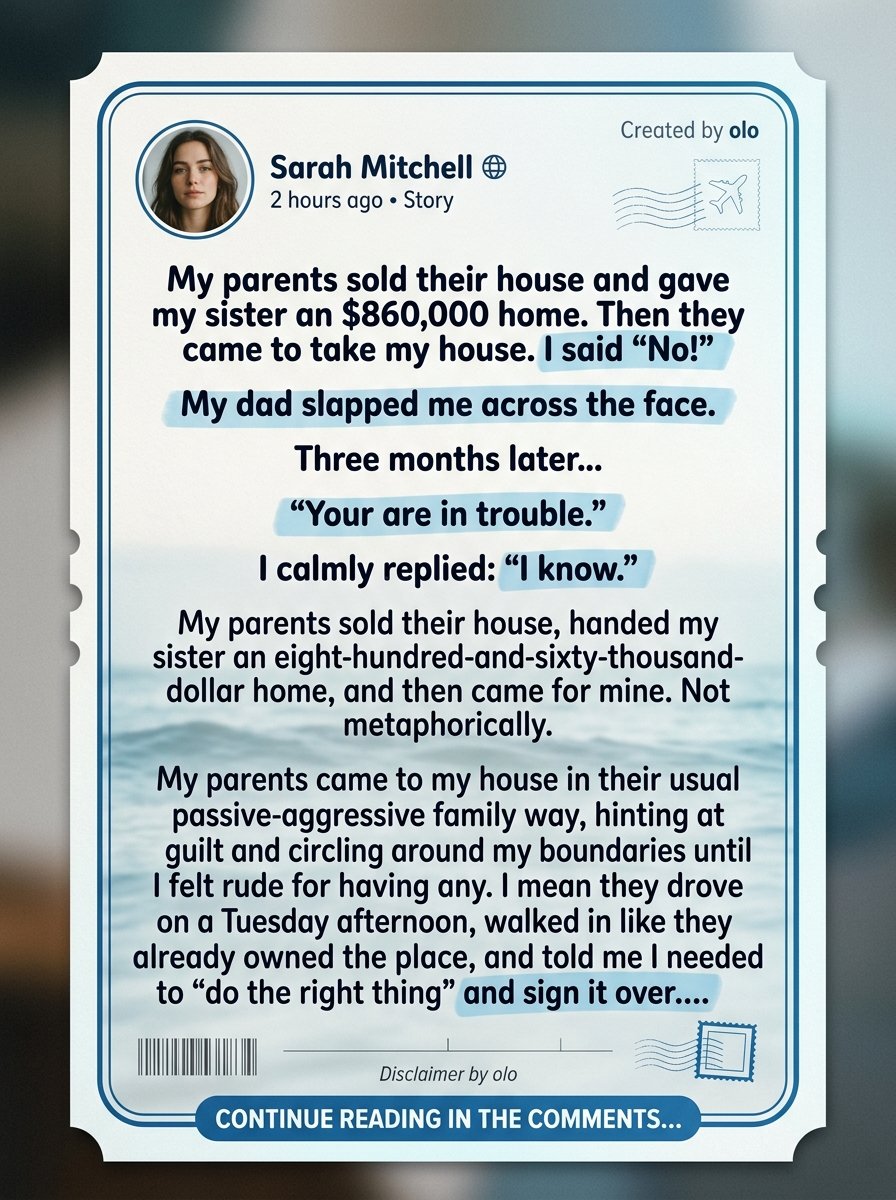
“You already gave her an $860,000 home. What exactly have I done wrong by keeping the house I bought with my own money?”
My mother’s expression hardened.
“Don’t be selfish. Your sister has children. You live alone. You don’t need all this space.”
Jessica finally looked up.
“Honestly, you’ve always been difficult. Just sign it over and stop making everything about you.”
For a moment, I almost laughed.
These were the same people who had celebrated Jessica’s new home with champagne and photographs while barely acknowledging the years I’d worked overtime to afford mine.
And when I’d refused to hand over my property, my father had slapped me.
Now they were sitting in my kitchen expecting me to apologize.
I stood up, picked up the folder, and slid it back across the table.
“My answer is no.”
My father’s face turned red.
“You’ll regret this!”
“Maybe,” I replied. “But at least I’ll regret my own decisions.”
They stormed out, slamming the door behind them.
I thought that was the end of it.
I was wrong.
That evening, I received a message from my aunt.
Your parents say you’re throwing the family away over a house. Please call them and make this right.
Then another message arrived from my cousin.
How could you leave your parents with nowhere to go?
I read it twice.
Nowhere to go?
My parents still had their money, their savings, and the proceeds from selling their house.
But apparently, in their version of the story, I was the villain.
Then, at 9:17 p.m., my phone rang.
It was my father.
I answered.
His voice was strangely calm.
“Tomorrow morning, you’re going to understand why you should have listened to us.”
I said nothing.
He hung up.
And for the first time, I wondered what they had planned next.
Because my father wasn’t the kind of man who threatened people without believing he had leverage.
And the next morning, I discovered exactly what he thought he had.
PART 3: “YOU’RE IN TROUBLE.” — “I KNOW.”
At 8:03 the next morning, someone knocked on my door.
Not my parents.
A woman in a dark blazer stood on my porch holding a document folder.
“Are you the owner of this property?” she asked.
“Yes.”
She introduced herself as an attorney representing my parents.
My stomach tightened, but I stepped aside and invited her to explain.
She sat at my kitchen table and opened the folder.
“Your parents believe you have an obligation to transfer this property to your sister.”
I almost smiled.
“An obligation under what agreement?”
She paused.
Then she explained that my parents had told her I had promised to give Jessica the house.
I stared at her.
“I never made that promise. The property is in my name. I purchased it, and I’ve paid for it myself.”
The attorney looked down at her papers.
“Do you have documentation?”
I opened my laptop.
Mortgage statements. Purchase documents. Property records. Years of payments.
Everything was there.
She reviewed the information, then slowly closed the folder.
“I’ll need to discuss this with my clients.”
“Of course,” I replied.
After she left, I called my own attorney and explained everything, including the slap, the threats, and their demand that I sign over my property.
He told me not to sign anything, not to surrender access to my home, and to preserve every message and document.
For the first time in days, I felt like I could breathe.
Then three months passed.
I heard almost nothing from my parents.
No calls. No apologies. No birthday message.
I assumed they’d finally accepted that my house wasn’t theirs to give away.
Then, on a rainy Tuesday afternoon, my mother called.
“Your father and I are coming over. We need to discuss something important.”
An hour later, they stood at my front door.
My father looked older. My mother looked nervous.
They walked into the living room, and my father sat down without asking.
Then he looked at me and said the words I’d been waiting to hear.
“Your are in trouble.”
I corrected him quietly.
“You mean I’m in trouble?”
He ignored me.
“Your sister’s situation has become complicated. We need you to help us. You have to sign the house over now.”
I looked at my mother.
Then at my father.
Then I calmly replied:
“I know.”
He frowned.
“What do you mean, you know?”
I reached into a drawer and placed an envelope on the table.
Inside were copies of the property records, their messages demanding my house, and the written account I’d made after my father slapped me.
But there was one more document.
A letter from my attorney explaining that I had no legal obligation to transfer my property and that any further attempts to pressure me would be documented.
My father’s confidence disappeared.
My mother picked up the letter with trembling hands.
“Where did you get this?”
I looked her directly in the eyes.
“From the lawyer you sent to my house.”
Silence filled the room.
Then my phone buzzed.
A message from Jessica appeared on the screen.
Mom says you have documents. Please don’t show anyone what happened with the house.
I read it.
Then I looked at my parents.
“Interesting,” I said. “Because I haven’t told anyone what I discovered about the house you gave her.”
My father’s face went pale.
My mother whispered, “What did you discover?”
I picked up my phone.
And for the first time in my life, they were the ones waiting for me to speak.
Because the $860,000 house they had given Jessica came with a secret they never expected me to uncover.