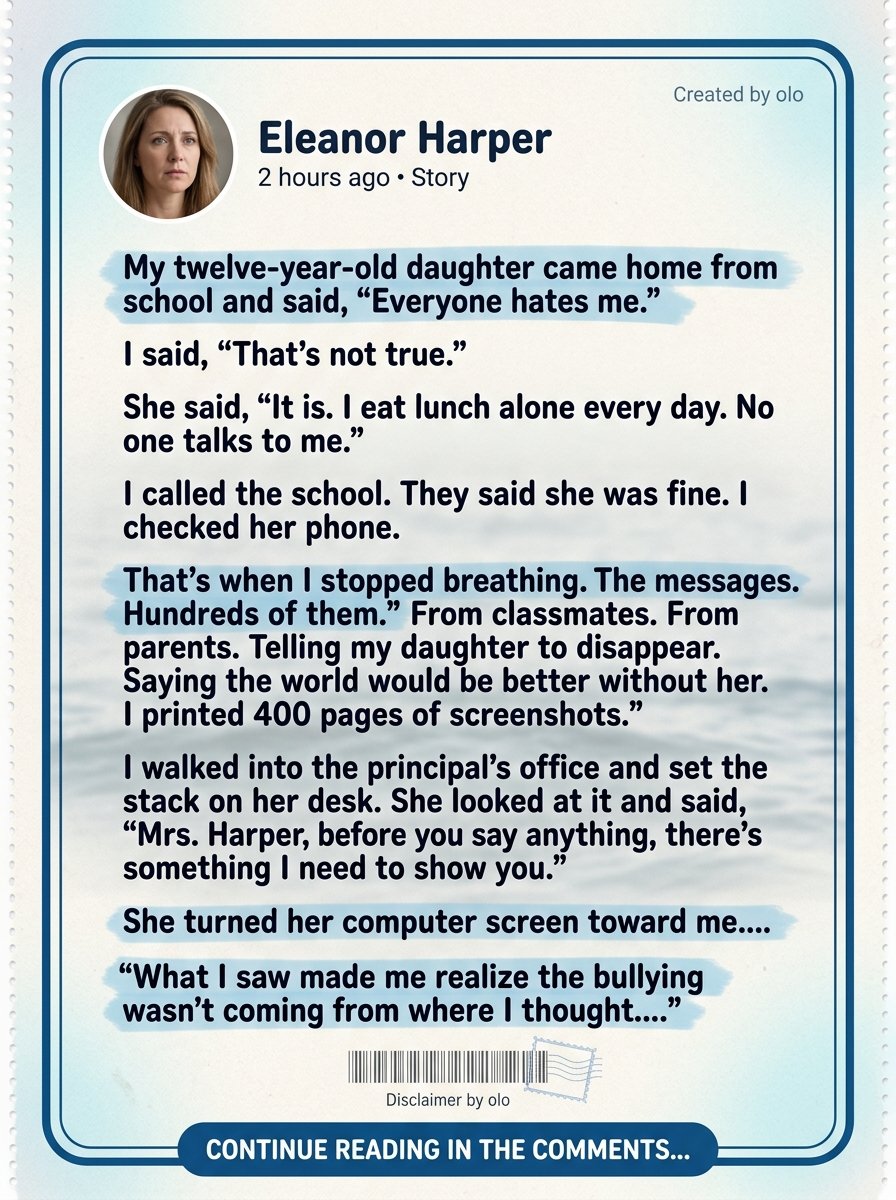
Mrs. Harper turned her computer screen toward me.
“Before you look at these messages,” she said quietly, “I need you to understand something. Your daughter isn’t the only student who has been targeted.”
My stomach tightened.
She opened a folder.
Inside were screenshots of conversations between students. Some were cruel jokes. Others were threats. And several contained the same phrase I’d read hundreds of times on my daughter’s phone.
“The world would be better without you.”
I gripped the edge of her desk.
“Who started this?”
Mrs. Harper hesitated.
“We believe it began in a private group chat. But the messages weren’t written by just one student. Several students participated, and some adults may have made the situation worse.”
“Adults?” I repeated.
She nodded.
Then she opened an email.
It had been sent to the school weeks earlier by a parent who claimed my daughter was causing problems in class.
The email described my twelve-year-old as manipulative, attention-seeking, and dangerous to other students.
None of the accusations had been investigated properly.
And the worst part?
The school had received several complaints about the harassment before I ever walked through the principal’s door.
I stared at Mrs. Harper.
“You knew?”
Her eyes filled with tears.
“I knew there was a problem. I didn’t understand how bad it had become. I was told the students had worked things out.”
I pushed the 400 printed pages toward her.
“My daughter comes home every day believing nobody wants her alive. She sits alone at lunch. She cries in her bedroom. And everyone keeps telling me she’s fine.”
Mrs. Harper lowered her head.
“You’re right.”
For a moment, I didn’t know what to say.
Then she whispered something that made my heart race.
“There’s one more thing. Yesterday, I found out who created the original group chat.”
I leaned forward.
“Who?”
She turned the screen toward me.
There was a name at the top of the conversation.
The student who started it was the principal’s own daughter.
I felt the room tilt.
But before I could respond, Mrs. Harper shook her head.
“Please don’t misunderstand. The principal’s daughter didn’t write every message. But she created the group, invited the students, and encouraged them to exclude your daughter.”
I looked at the office door.
“Does the principal know?”
Mrs. Harper didn’t answer.
She didn’t need to.
At that moment, the door opened.
The principal stepped inside, saw the screenshots on the screen, and froze.
Then she looked directly at me.
“Mrs. Harper,” she said, “I was hoping we could handle this privately.”
I stood up.
“Privately?”
My voice shook, but I didn’t look away.
“My daughter has been suffering in public for months. Why should the truth be handled privately?”
The principal closed the door behind her.
And what she said next changed everything.
“Because if these messages become public, my daughter won’t be the only person who gets hurt.”
I stared at her.
For the first time, I understood.
This wasn’t just about a group of children being cruel.
It was about adults who had something to lose.
And they were about to discover that I wasn’t going to look away.
PART 3: The Day the Silence Finally Broke
I didn’t scream.
I didn’t threaten to destroy anyone’s career.
I took out my phone, called my husband, and asked him to meet me at the school.
Then I looked at the principal.
“I’m not here to ruin your daughter’s life. She’s twelve, too. She deserves guidance, consequences, and a chance to learn from what she’s done.”
The principal seemed surprised.
“But my daughter—”
“I’m not finished,” I interrupted. “My daughter deserves the same protection.”
For several seconds, nobody spoke.
Then I placed my phone on the desk.
“I want every complaint reviewed. I want the school to preserve the messages and investigate every student involved. I want a plan to keep my daughter safe, and I want to know why earlier reports were dismissed.”
The principal looked at the 400 pages.
For once, she had no quick answer.
By lunchtime, the school had begun a formal investigation. The students involved were interviewed, parents were contacted, and the school started putting safety measures in place.
But the biggest moment came three days later.
My daughter came home, dropped her backpack by the door, and stood in the kitchen.
“Mom?”
I turned from the stove.
“Yes, sweetheart?”
“Can I tell you something without you getting upset?”
I put down the spoon.
“Always.”
She took a shaky breath.
“I knew about the group chat.”
My heart sank.
“What do you mean?”
“I found out about it weeks ago. Someone showed me a screenshot. I didn’t tell you because I thought it would get worse.”
She began crying.
“And I thought maybe they were right about me.”
I crossed the kitchen and held her.
“No, baby. Absolutely not.”
“But why did they hate me?”
I took a moment before answering.
“Sometimes people hurt others because they want approval, because they’re afraid of being excluded themselves, or because nobody has taught them to take responsibility for their actions. But none of those reasons makes what they did your fault.”
She buried her face in my shoulder.
“I just wanted one friend.”
Those five words broke my heart more than all 400 pages.
I held her until she was ready to let go.
Over the following weeks, the school continued its investigation. The students responsible faced appropriate disciplinary consequences, and the school reviewed how it handled reports of bullying. Some families apologized. Others didn’t.
We couldn’t force everyone to understand what they’d done.
But we could make sure my daughter wasn’t left to face it alone.
One Friday afternoon, she came home with something I hadn’t seen in months.
A smile.
“What happened?” I asked.
She pulled a folded piece of paper from her backpack.
“Someone invited me to sit with them at lunch.”
I unfolded it.
It was a simple note from another girl in her class.
“Hey, I know things have been hard. You can sit with us tomorrow if you want.”
I felt tears fill my eyes.
“Are you going to go?”
My daughter nodded.
“I’m scared.”
“That’s okay,” I told her. “Being brave doesn’t mean you’re never scared. It means you don’t have to let fear make every decision for you.”
She smiled again.
That night, after she went to bed, I returned to the stack of printed messages.
Four hundred pages.
Four hundred reminders of what happens when cruelty becomes entertainment and silence becomes permission.
I put them in a folder for the ongoing investigation.
Then I wrote one sentence on the front:
“The next child who asks for help deserves to be believed before 400 pages of proof are necessary.”
Because the greatest failure wasn’t simply that children had bullied my daughter.
It was that the warning signs had been there, and the adults responsible for protecting her hadn’t acted soon enough.
And if there’s one thing I learned from all of this, it’s this:
You don’t have to teach your child to become stronger than the cruelty surrounding them. You have to teach them that they deserve protection from it in the first place.
Sometimes, the most important thing a parent can say isn’t “Ignore them.”
It isn’t “Be tougher.”
It’s this:
“I believe you. I’m listening. And we’re going to face this together.”