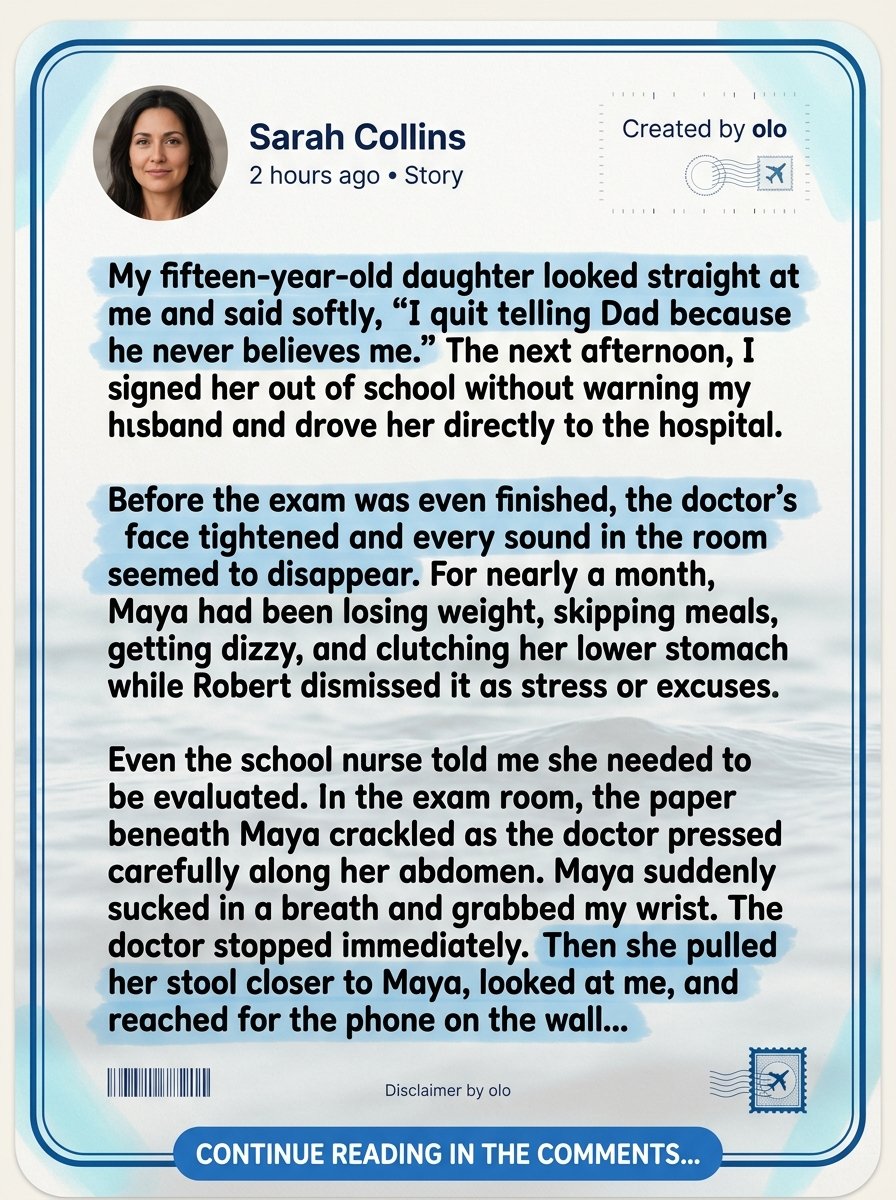
The doctor reached for the phone and asked a nurse to bring in the ultrasound machine immediately.
My heart began pounding.
“Doctor, what is happening to my daughter?” I asked.
She glanced at Maya, then back at me. “I need to run a few tests before I can give you a definite answer. But I don’t want you to leave this hospital.”
Maya squeezed my hand so tightly that my fingers hurt.
“Mom,” she whispered, tears rolling down her cheeks. “Please don’t let Dad come here.”
Those words hurt more than anything the doctor could have told me.
“Why, sweetheart? What are you afraid of?”
She shook her head and stared at the floor.
The ultrasound began. The room fell silent except for the soft hum of the machine. The doctor moved the probe carefully across Maya’s lower abdomen, studying the screen.
Then she stopped.
She adjusted the machine, examined the image again, and called another physician into the room.
I felt the blood drain from my face.
“What do you see?” I demanded.
The second doctor studied the screen before speaking quietly to her colleague.
“We need to admit her for further evaluation. There is something here that requires immediate attention.”
Maya began crying.
And then, for the first time in nearly a month, she told me everything.
She had been experiencing severe abdominal pain for weeks. Sometimes it became so intense that she could barely stand. She had tried telling her father, Robert, but he accused her of exaggerating to avoid school and household responsibilities.
When she asked him to take her to a doctor, he told her to stop being dramatic.
Eventually, she stopped asking.
“I thought nobody would believe me,” she sobbed. “I thought maybe I was just weak.”
I pulled her into my arms.
“You are not weak. And you should never have had to suffer in silence.”
A few minutes later, the doctor returned with the preliminary results.
Maya had a serious abdominal condition that required urgent specialist assessment. The doctors explained that they needed additional imaging and blood tests to determine its exact cause and the best treatment.
But there was something else they wanted to discuss.
The doctor asked to speak with me privately.
When we stepped into the hallway, she looked directly into my eyes.
“Your daughter has been trying to tell someone that something is wrong. Whatever happens next, she needs to know that the adults in her life will listen.”
I nodded, fighting back tears.
Then my phone began vibrating.
Robert.
I stared at his name on the screen.
For the first time in fifteen years of marriage, I wasn’t afraid of his reaction.
I was afraid of what might have happened if I had listened to him instead of my daughter.
I answered.
“Where are you?” he demanded. “The school called and said you took Maya out without telling me.”
“We’re at the hospital.”
There was a pause.
“What? Why?”
“Because our daughter has been in pain for weeks, Robert. Because she’s been losing weight and getting dizzy. Because she begged you to listen, and you called her a liar.”
“She’s always been sensitive—”
“Stop.”
My voice was so firm that even I barely recognized it.
“You don’t get to dismiss this anymore. The doctors are examining her, and she is staying here until they know what’s wrong.”
He went quiet.
Then he said something I would never forget.
“You’re making me look like a terrible father.”
I closed my eyes.
And I finally understood that he was still more concerned about how he looked than about how our daughter felt.
“Robert,” I said quietly, “right now, this isn’t about you.”
Then I hung up.
But I had no idea that the hardest conversation of my life was still waiting for me.
## Part 3: The Truth That Changed Our Family Forever
By evening, Maya had been admitted to the hospital.
The doctors continued their examinations, carefully monitoring her symptoms while a specialist reviewed her scans.
I stayed beside her bed, holding her hand whenever she woke.
Around midnight, she opened her eyes.
“Mom?”
“I’m here, sweetheart.”
“Are you angry with me?”
The question broke my heart.
“Angry with you? Why would I be angry with you?”
“Because I didn’t tell you everything sooner.”
I moved closer and brushed the hair away from her forehead.
“Listen to me, Maya. You are fifteen years old. You are allowed to be scared. You’re allowed to need help. And you never have to prove that you’re hurting before I take you seriously.”
She started crying again.
This time, though, she wasn’t trying to hide it.
The following morning, the specialist sat down with us and explained the findings. Maya had a significant medical problem that needed treatment, but the initial tests alone could not establish every detail. The team outlined the next steps, the possible risks, and the treatment options.
For the first time in weeks, we had a plan.
I felt relief, but it came mixed with guilt.
How many warning signs had I missed? How often had I accepted Robert’s explanation because it was easier than challenging him?
I had seen Maya pushing food around her plate. I had noticed her becoming quieter. I had watched her disappear into her bedroom after arguments.
I had told myself it was adolescence.
Now I understood that I should have asked more questions.
Later that afternoon, Robert arrived at the hospital.
He walked into the room carrying flowers, his expression tense.
“Maya, sweetheart,” he said, approaching her bed. “Your dad is here.”
She immediately turned toward me and gripped my hand.
“Please don’t make me talk to him,” she whispered.
Robert stopped.
For a moment, nobody spoke.
Then he looked at me.
“Are you seriously going to let her treat me like this?”
I stood up.
“No. I’m going to let her decide when she feels safe enough to speak to you.”
His face reddened.
“I’m her father\!”
“And she’s your daughter,” I replied. “She came to you in pain, and you dismissed her. She asked for help, and you made her feel ashamed for asking.”
“I didn’t know it was serious\!”
“That’s exactly the point, Robert. You didn’t know because you wouldn’t listen long enough to find out.”
He looked toward Maya.
She was crying silently, her eyes fixed on the blanket.
For once, he had no immediate response.
I asked him to step into the hallway with me.
There, away from Maya, I told him that things had to change.
He needed to acknowledge the harm his dismissal had caused. He needed to listen without accusing her of lying or exaggerating. And he needed to understand that being a parent didn’t give him the right to make his child afraid to speak.
“I made a mistake,” he muttered.
“Yes,” I said. “But the question is whether you’re willing to change.”
He looked down at the flowers in his hands.
“I didn’t think it was this bad.”
I took a breath.
“Then learn to listen before it becomes this bad.”
Robert didn’t suddenly transform into a perfect father that afternoon. An apology couldn’t erase weeks of fear, and a promise couldn’t instantly restore Maya’s trust.
That would take time.
But when he returned to the room, he didn’t demand a hug or insist that she forgive him.
He placed the flowers on the table and stood a few feet from her bed.
“Maya,” he said, his voice trembling, “I was wrong to dismiss you. You tried to tell me you were hurting, and I didn’t listen. I’m sorry.”
Maya looked at him for several seconds.
“I need you to believe me next time,” she whispered.
Robert nodded.
“I will try. And I’ll show you that with my actions.”
She didn’t rush into his arms.
She simply turned back toward me and held my hand.
And that was enough for that day.
Over the following weeks, Maya received the medical care she needed. Her recovery required patience, follow-up appointments, and support from the people around her. We also began rebuilding the trust that had been damaged long before we entered that hospital.
I learned to ask questions instead of assuming everything was fine.
Robert had to learn that listening was not the same as agreeing, and that taking a child’s pain seriously was never a sign of weakness.
Most importantly, Maya began to understand that her voice mattered.
One evening, as I tucked her into bed, she looked at me and said, “Mom, thank you for believing me.”
I kissed her forehead.
“You should never have had to thank me for that.”
Because the truth is, children don’t always know how to explain what they’re feeling. Sometimes they minimize their pain. Sometimes they stay silent because they’ve been taught that speaking up will only get them into trouble.
And sometimes, the bravest thing a parent can do is admit they were wrong.
Never make your child prove their suffering before you take it seriously.
You may not always know what’s wrong. You may not have an immediate answer. But you can always listen, ask questions, and help them find the care they need.
Because when a child finally whispers, “Nobody believes me,” the most important thing you can do is make sure they never have to face that fear alone.