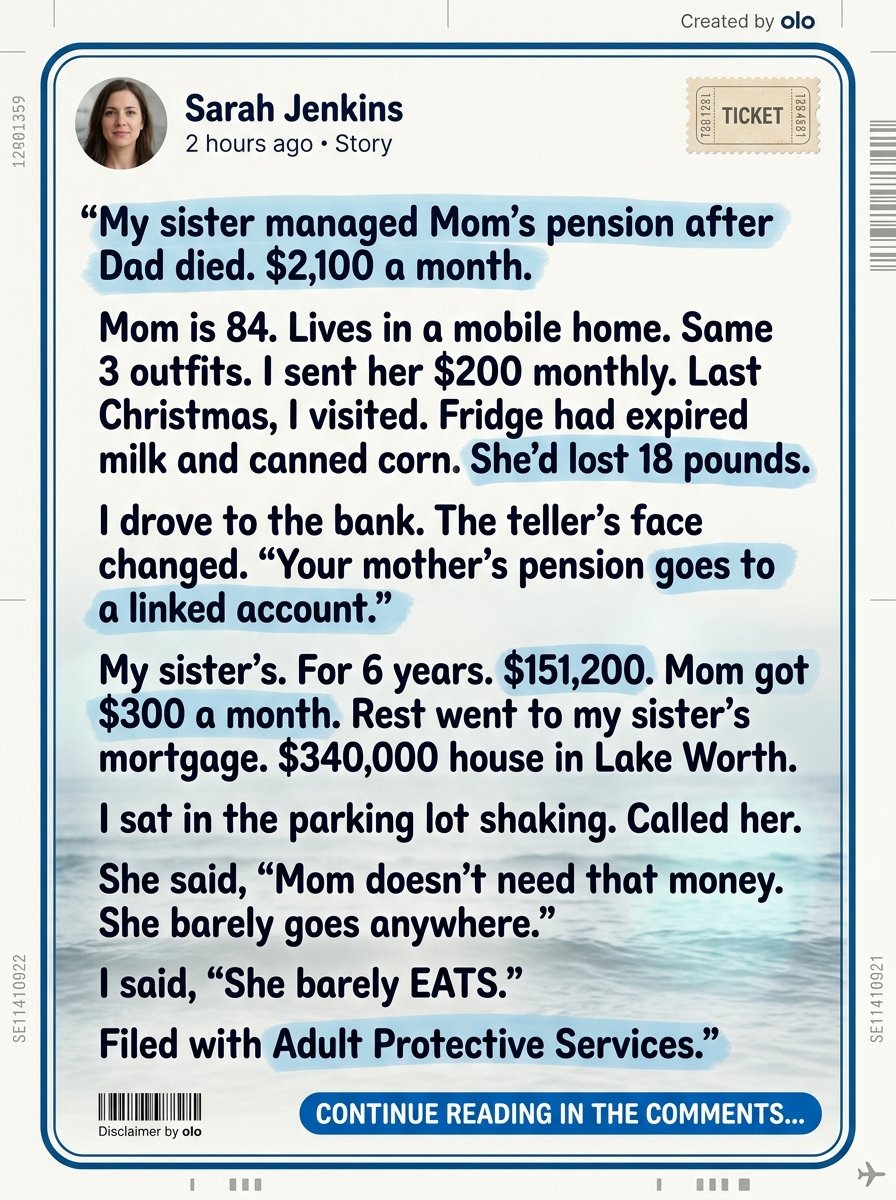
Three days after I reported my sister to Adult Protective Services, Mom called me in tears.
“Please don’t be angry with your sister,” she whispered. “She said you could get her arrested. I don’t want my family to fall apart.”
I sat on the edge of my bed, gripping the phone.
“Mom, you’re not the one who should be afraid. You haven’t done anything wrong.”
“But she said she was only borrowing the money. She promised she’d pay it back.”
Borrowing it?
For six years?
I asked Mom how long she’d known that her pension wasn’t going toward her expenses.
There was a long silence.
“Your sister told me the money was being saved for emergencies,” Mom finally admitted. “She said I spent too much when your father was alive. She said she needed to manage everything because I wasn’t good with money anymore.”
My heart broke.
Dad had trusted my sister to protect Mom. Instead, Mom had been made to feel guilty for needing the very money that belonged to her.
“Mom, did she ever tell you how much was in your account?”
“No.”
“Did you know she was paying her mortgage with your pension?”
Mom began crying harder.
“No, honey. I thought the house was paid for.”
I closed my eyes.
Then Mom said something that made me furious.
“She told me not to tell you about the groceries. She said you already had enough problems of your own.”
That explained why Mom had never asked me for more help.
She had been protecting the daughter who was leaving her hungry.
The following morning, I drove to Mom’s mobile home with groceries, fresh clothes, and enough food to fill her refrigerator.
When I opened the door, Mom looked frightened.
“Your sister said you might come.”
“That’s okay, Mom. I’m here to see you.”
I spent the afternoon cooking meals and organizing her kitchen. I also helped her arrange a medical appointment because I was worried about her weight loss.
While we sat at the table, I asked if she would be willing to speak with the investigators.
Mom looked down at her hands.
“What if your sister stops talking to me?”
I reached across the table.
“What if something happens to you because you’re afraid to tell the truth?”
She looked up at me, and for the first time, I saw something other than fear in her eyes.
Determination.
“I don’t want anyone else to go hungry because of me,” she whispered.
I promised her she wouldn’t have to face this alone.
Meanwhile, the bank’s fraud department began reviewing the transactions I had reported. I gathered the statements I could legally obtain, along with records showing the pension deposits and the amounts Mom had received.
The numbers were devastating.
Six years of pension payments.
Only $300 a month reaching Mom.
And a mortgage that had continued to be paid while Mom struggled to afford groceries.
Then my sister made her next mistake.
She called me.
“You need to withdraw that report,” she demanded.
“Why?”
“Because you’re destroying this family!”
“I’m trying to protect Mom.”
“She doesn’t understand money! I was managing things for her!”
“Then why was she starving?”
My sister went silent.
Finally, she said, “You have no idea what I’ve sacrificed.”
I asked her one question.
“Did Mom ever give you permission to use her pension for your mortgage?”
She hung up.
That evening, I received a message from an unknown number.
It contained a photograph of a document.
At the top was Mom’s name.
Below it was a signature that supposedly authorized my sister to manage her finances.
But there was one problem.
The signature was dated during a month when Mom had been hospitalized and physically unable to visit the bank.
I stared at the photograph, unable to believe what I was seeing.
I forwarded it to the investigator and asked that the document’s authenticity be examined.
I didn’t know who had sent the message.
I didn’t know whether the signature was genuine.
But I knew one thing.
My sister had spent six years telling everyone she was protecting Mom.
Now, for the first time, there was evidence that could help determine whether that story was true.
And the next phone call would change everything.
Part 3 was about to begin.
Part 3: The Bank Records Changed Everything
The next morning, an investigator contacted me.
She asked whether Mom was safe, whether my sister had access to her home, and whether anyone had threatened her.
I explained what Mom had told me about being warned not to speak.
The investigator took the information seriously and explained that the financial records and the document I had received would need to be examined.
I asked how long the investigation would take.
“It’s difficult to predict,” she said. “But please continue documenting what you discover, and let us know if your mother is threatened or her access to necessities is restricted.”
I thanked her and called Mom.
She answered after several rings.
“Sweetheart, your sister was here again.”
My stomach tightened.
“What happened?”
“She wanted me to sign something.”
“What kind of something?”
“She said it would prove she had done nothing wrong. But I couldn’t understand the papers, so I told her I wanted to wait until you came.”
I felt relieved.
“Mom, you did the right thing. Never sign anything you don’t understand. We’ll find someone independent who can explain it to you.”
Then Mom said, “She got angry.”
I asked if she felt safe staying at home.
“Yes,” she said quietly. “But I don’t like being afraid of my own daughter.”
Neither did I.
Over the next several days, I helped Mom arrange regular meals and medical care. I also contacted the appropriate bank representatives to ask how her pension deposits could be protected while the allegations were reviewed.
I didn’t want revenge.
I wanted Mom to have food in her refrigerator, heat in her home, and control over her own money.
Then the investigator called again.
The bank had provided records for review.
Some transactions appeared consistent with the transfers I had reported. However, determining whether those transfers were authorized—and whether any laws had been broken—would require further examination.
The investigator also wanted to speak with Mom privately.
I drove her to the appointment.
Mom wore one of her three familiar outfits, a blue cardigan that had become too loose around her shoulders.
Before we entered the building, she took my hand.
“What if they don’t believe me?”
I looked at her.
“Mom, you don’t have to remember every date or every dollar. Just tell them what you know and what you remember.”
Inside, the investigator spoke with her without me in the room.
When Mom came out, her eyes were red, but her shoulders seemed lighter.
“I told them everything,” she said.
I hugged her.
For the first time, Mom had spoken about what had happened without worrying about protecting my sister.
Two days later, my sister showed up at my house.
She looked furious.
“You’ve turned Mom against me,” she said.
“No. I asked questions when I realized she wasn’t being cared for.”
“I paid bills! I handled everything! You have no idea how much work it was!”
“Then show the investigators the records. Explain where the money went.”
She stepped closer.
“You think you’re some kind of hero because you send her $200 a month?”
“No,” I said. “I think Mom deserves to eat.”
Her face changed.
For a moment, neither of us spoke.
Then she said, “If I lose my house over this, you’ll have destroyed my life.”
I felt tears gathering in my eyes.
“Mom was losing weight while you were paying your mortgage. What did you think was happening to her life?”
My sister turned away.
She left without another word.
Weeks passed.
The investigation continued, and I learned that financial disputes involving family members could take time to resolve. I was careful not to assume that every allegation had been proven, and I let the appropriate authorities examine the evidence.
In the meantime, Mom began receiving help with groceries and medical appointments. We worked on making sure her finances were managed in a way that respected her wishes and protected her independence.
One afternoon, I visited her and found her sitting at the kitchen table.
Her refrigerator was full.
There was fresh fruit in a bowl, soup on the stove, and a grocery list beside her chair.
She looked up and smiled.
“I had a good lunch today.”
I sat down beside her and cried.
Not because everything was fixed.
It wasn’t.
The money had not magically returned, the investigation was not finished, and our family was still fractured.
I cried because my mother had finally begun to feel safe enough to tell the truth.
A few weeks later, she asked me something I will never forget.
“Do you think your sister ever loved me?”
I took her hand.
“I think love should mean making sure someone is safe, even when it’s inconvenient. And I think you deserve that kind of care.”
Mom nodded slowly.
Then she looked toward the refrigerator.
“Would you like some soup?”
I smiled through my tears.
“Yes, Mom. I’d love some.”
That day, we ate together at her little kitchen table.
There was no grand victory. No dramatic courtroom confession. No instant recovery of six years of missing money.
Just a mother who finally had food, a daughter who refused to stay silent, and a family forced to confront questions that should have been asked years earlier.
I still don’t know exactly what justice will look like.
But I know what I will never forget.
My mother didn’t need someone to decide that her life was worth less because she rarely went anywhere. She needed someone to recognize that she still deserved dignity, nourishment, and the freedom to control her own future.
And I will never again mistake silence for proof that someone is okay.
The end.