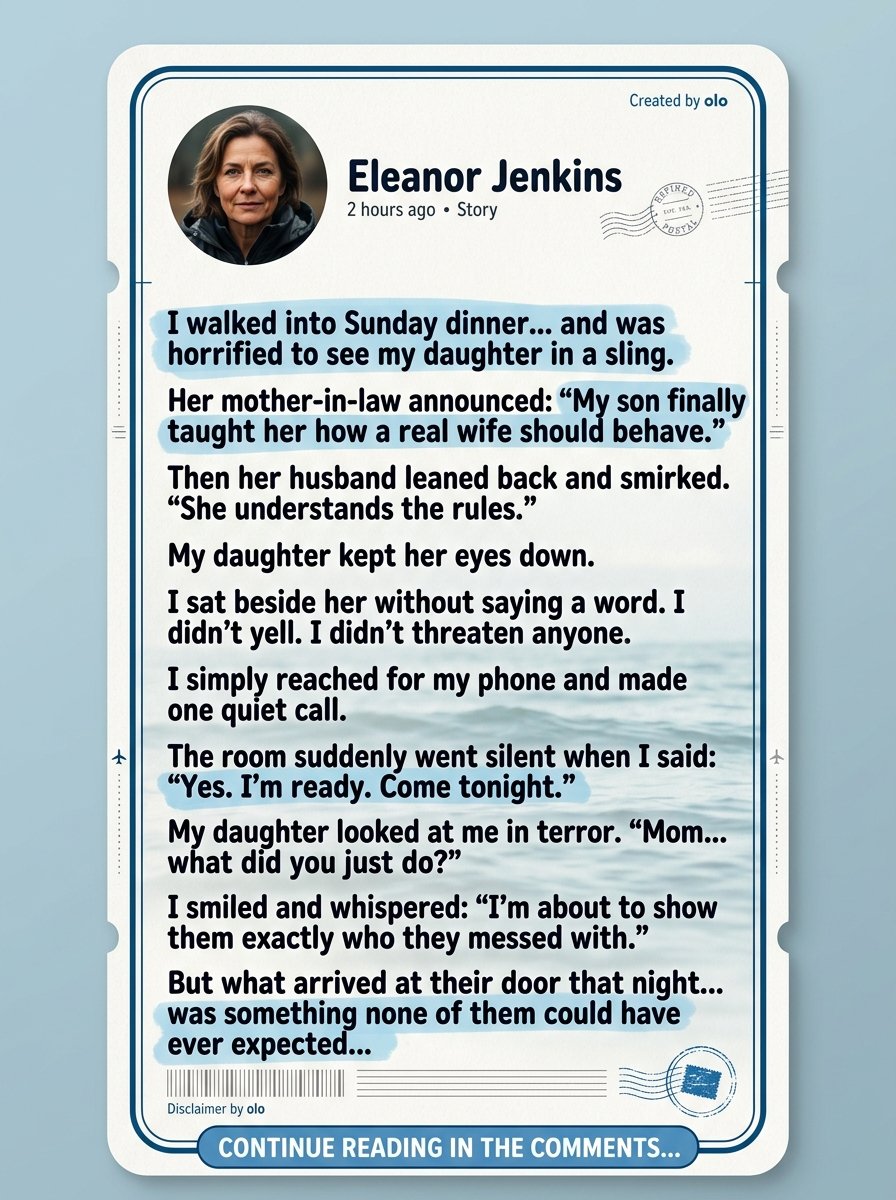
At exactly 8:17 that evening, someone knocked on their front door.
My son-in-law stopped smiling.
His mother stood up from the couch, irritated. “Who comes knocking this late?”
I looked at my daughter and gently squeezed her hand.
“Stay beside me, sweetheart. You don’t have to be afraid anymore.”
The door opened.
Standing outside were three people.
A police officer. A woman carrying a leather briefcase. And a tall man in a dark suit holding a thick folder.
My son-in-law’s face turned pale.
“What’s this supposed to be?” he demanded.
The woman with the briefcase stepped forward.
“My name is Rebecca Collins. I’m an attorney representing your wife’s interests. We received photographs of her injuries, along with messages documenting repeated threats and abuse.”
His mother immediately interrupted.
“This is a family matter! You have no right to interfere!”
The police officer spoke calmly.
“Ma’am, whether it’s a family matter or not, suspected domestic violence is a serious matter. We need to speak with everyone involved.”
My daughter began trembling.
Her husband pointed at me.
“You planned this! You think you can destroy my life?”
I finally looked him directly in the eyes.
“No,” I replied. “You started destroying your own life the first time you raised your hand against my daughter.”
Then the man in the dark suit stepped forward.
And when my son-in-law recognized him, he took one step backward.
Because that man wasn’t just any lawyer.
He was the attorney who had handled the legal affairs of my late husband’s company.
And he knew something about my son-in-law that nobody in that room expected.
“Before anyone says another word,” the attorney announced, opening his folder, “there’s something you need to understand about the house you’re standing in.”
My daughter looked confused.
Her mother-in-law suddenly went silent.
And for the first time that evening, I saw genuine fear in my son-in-law’s eyes.
Because the house he had spent years bragging about…
Wasn’t his.
PART 3: THE SECRET BEHIND THE HOUSE
“You’re lying!” my son-in-law shouted.
The attorney didn’t raise his voice.
He simply placed a document on the table.
“This property was purchased through a family trust established by your wife’s late father. The deed and trust records establish who holds the legal interest in the property. Your name does not appear as an owner.”
My son-in-law stared at the papers.
His mother snatched them from the table.
“This is impossible! My son paid for this house!”
“Then I’m sure you’ll have receipts to support that claim,” the attorney replied.
She had nothing to say.
I watched them scramble for excuses, and I remembered the day my daughter had called me crying because her husband insisted that she quit her job.
“He says a good wife doesn’t need her own money, Mom,” she’d whispered.
I had wanted to confront him then.
But my daughter begged me not to interfere.
She believed she could fix the marriage.
She believed that if she became more patient, more obedient, and more loving, he would return to the man she had married.
Instead, his demands became rules.
She couldn’t visit friends without permission.
She couldn’t spend money without explaining every purchase.
And whenever she questioned his mother, her husband accused her of disrespecting the family.
Then came the night he injured her arm.
And Sunday dinner was the first time I had seen the full extent of what was happening.
Now, standing in that living room, I made a decision.
“My daughter is leaving with me tonight,” I announced.
My son-in-law stepped forward.
“She isn’t going anywhere! She’s my wife!”
The police officer immediately moved between us.
“Step back, sir.”
For once, he obeyed someone else’s rules.
His mother began crying, but not for my daughter.
“What will people think? You’ve embarrassed this family!”
I turned toward her.
“Your concern is what people will think. Mine is what my daughter has been living through.”
Then my daughter finally lifted her head.
Her voice was quiet, but every word landed like a stone.
“You told me that a real wife obeys her husband.”
She looked at her mother-in-law.
“And you told me that suffering in silence made me a good wife.”
Then she turned to the man she had once loved.
“But nobody ever told me that I was allowed to leave.”
The room fell silent.
I reached for her hand.
“You never needed anyone’s permission to be safe, sweetheart.”
We walked out together.
Behind us, her husband shouted that he would make us regret everything.
But this time, my daughter didn’t turn around.
The following weeks weren’t easy. There were legal appointments, difficult conversations, and nights when she woke from nightmares.
Healing didn’t happen in a single evening.
But slowly, she began smiling again.
She returned to work. She reconnected with old friends. She learned that she could make decisions without asking anyone for permission.
And one morning, as we sat together drinking coffee, she looked at me and asked a question I will never forget.
“Mom, why didn’t you say anything at dinner?”
I took her hand.
“Because, sweetheart, I wanted you to know that your pain wasn’t something you had to defend. I wanted you to see that you deserved help, even before you found the words to ask for it.”
She began to cry.
Then she leaned against my shoulder, just as she had when she was a little girl.
And I held her.
The house, the money, and the legal documents had never been the real victory.
The real victory was that my daughter finally understood she didn’t have to suffer to prove she was worthy of love.
And if there’s one thing I hope every parent remembers, it’s this:
When someone you love is being hurt, don’t mistake their silence for consent or their fear for weakness.
Sometimes, the bravest thing you can do is stand beside them until they are ready to stand on their own.
Because no marriage, no family tradition, and no reputation is worth more than a human being’s safety.
And no one should ever have to earn the right to be treated with kindness.