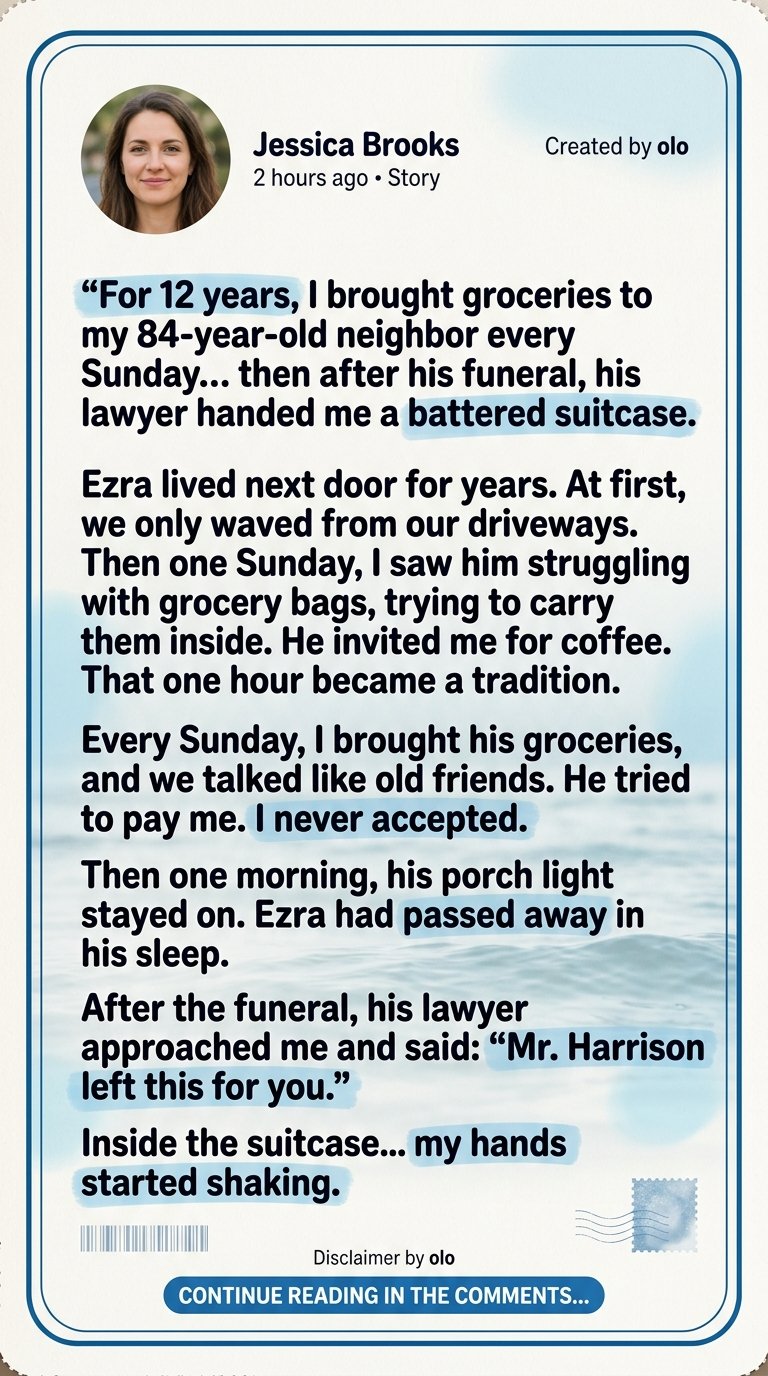
For 12 Years, I Delivered Groceries to My 84-Year-Old Neighbor Every Sunday—After His Funeral, His Lawyer Handed Me a Worn Suitcase That Changed My Life Forever
For twelve years, every Sunday morning followed the same quiet routine.
I’d stop by the local grocery store, pick up the same list—whole wheat bread, black coffee, oatmeal, canned peaches, fresh milk, and the newspaper—and carry everything to the small white house next door.
Ezra Harrison was eighty-four when our friendship began.
At first, we were just neighbors who exchanged polite waves. But one rainy Sunday, I saw him struggling to carry two heavy grocery bags up his porch steps. I rushed over to help.
“You’re going to hurt your back,” I joked.
He smiled.
“At my age, son, everything hurts.”
After putting the groceries away, he asked if I’d stay for a cup of coffee.
That coffee lasted almost two hours.
From then on, Sunday mornings belonged to us.
Sometimes we talked about baseball.
Sometimes about history.
Sometimes about nothing at all.
He told stories about growing up during hard times, meeting his wife Margaret at a county fair, serving in the Navy, losing her to cancer twenty years earlier, and learning how lonely a quiet house could become.
He always tried to hand me twenty dollars after I brought his groceries.
I always pushed it back across the table.
“I don’t need your money, Ezra.”
“Then why do you keep coming?”
“Because I’d want someone to do the same for my dad.”
His eyes always softened when I said that.
Years passed.
My own children grew up knowing “Mr. Ezra” as the sweet old man who gave them peppermint candy and terrible jokes.
He never missed one of their birthdays.
They never forgot his.
As time passed, his steps became slower.
His hands shook more.
His hearing faded.
But every Sunday, he’d already have the coffee brewing before I knocked.
Then one Sunday…
The porch light was still on.
At first I thought he’d forgotten to turn it off.
I knocked.
No answer.
I knocked harder.
Still nothing.
A terrible feeling settled in my stomach.
I called the police.
They entered through the back door.
A few minutes later, an officer walked back outside.
“I’m sorry.”
Ezra had passed away peacefully in his favorite recliner sometime during the night.
The funeral was small.
Only a handful of distant relatives attended.
Most of the people there were neighbors.
As everyone began leaving, a man in a gray suit approached me.
“Are you Daniel Carter?”
“Yes.”
“I’m Mr. Lawson, Mr. Harrison’s attorney.”
He held out an old, battered brown suitcase.
“Ezra wanted you to have this.”
I stared at it.
“There must be some mistake.”
“There isn’t.”
He smiled gently.
“He was very specific.”
When I got home, I placed the suitcase on the kitchen table.
The leather was cracked.
The brass latches were tarnished.
My wife sat beside me.
“You should open it.”
I slowly released the locks.
Inside were dozens of carefully labeled envelopes.
Every single one had a date written on it.
The earliest was twelve years old.
The newest had been written only three weeks before Ezra died.
There was also one envelope on top.
It simply read:
“To Daniel.”
With trembling hands, I unfolded the letter.
Dear Daniel,
If you’re reading this, I’ve finally joined Margaret.
First, thank you.
Not for the groceries.
Not for fixing my fence.
Not for shoveling my driveway.
Thank you for treating an old man like he still mattered.
Loneliness doesn’t kill you all at once.
It steals little pieces of you every day.
Every Sunday, you gave me one of those pieces back.
By this point, my eyes were filled with tears.
The letter continued.
You probably remember I always tried to pay you.
You always refused.
But I knew one day I’d find another way.
I looked deeper into the suitcase.
Every envelope contained twenty dollars.
One for every Sunday I had ever visited.
There were over six hundred envelopes.
Each one untouched.
He had saved the money I refused to accept.
At the bottom of the suitcase sat a small metal box.
Inside was a bank passbook.
The balance made my heart stop.
Over $275,000.
Another letter explained everything.
Ezra and Margaret had never had children.
After Margaret died, he’d sold a piece of family farmland that had unexpectedly become valuable when a technology company bought the surrounding property.
Rather than spend the money, he invested it.
His lawyer had helped him establish a trust years earlier.
The trust named me as the beneficiary.
But there was one condition.
I had to use part of the money to help lonely senior citizens.
Not because I owed him anything.
Because someone else might need a Sunday morning friend.
For weeks, I could hardly think about anything else.
Eventually, my wife and I decided to honor his wish.
We used a portion of the inheritance to start The Sunday Table, a local volunteer program that paired families with elderly neighbors who lived alone.
At first, only six volunteers signed up.
Within a year, there were more than one hundred.
They delivered groceries.
Shared meals.
Played cards.
Listened to stories.
Celebrated birthdays.
Attended doctor’s appointments.
Most importantly…
They showed up.
Five years later, the program had expanded into neighboring towns.
Thousands of seniors had found companionship.
Hundreds of volunteers said they’d received far more than they’d ever given.
Every Sunday morning, before visiting new members, I stop by one familiar place.
Ezra’s grave.
I bring fresh coffee.
I sit for a while.
And I tell him about the people whose lives continue to change because one lonely old man chose kindness over bitterness—and because he taught me that the greatest inheritance isn’t money.
It’s making someone feel remembered.
As I stand to leave, I always smile and say the same words:
“See you next Sunday, my friend.”
Sometimes the smallest weekly act becomes the biggest legacy a person can leave behind.