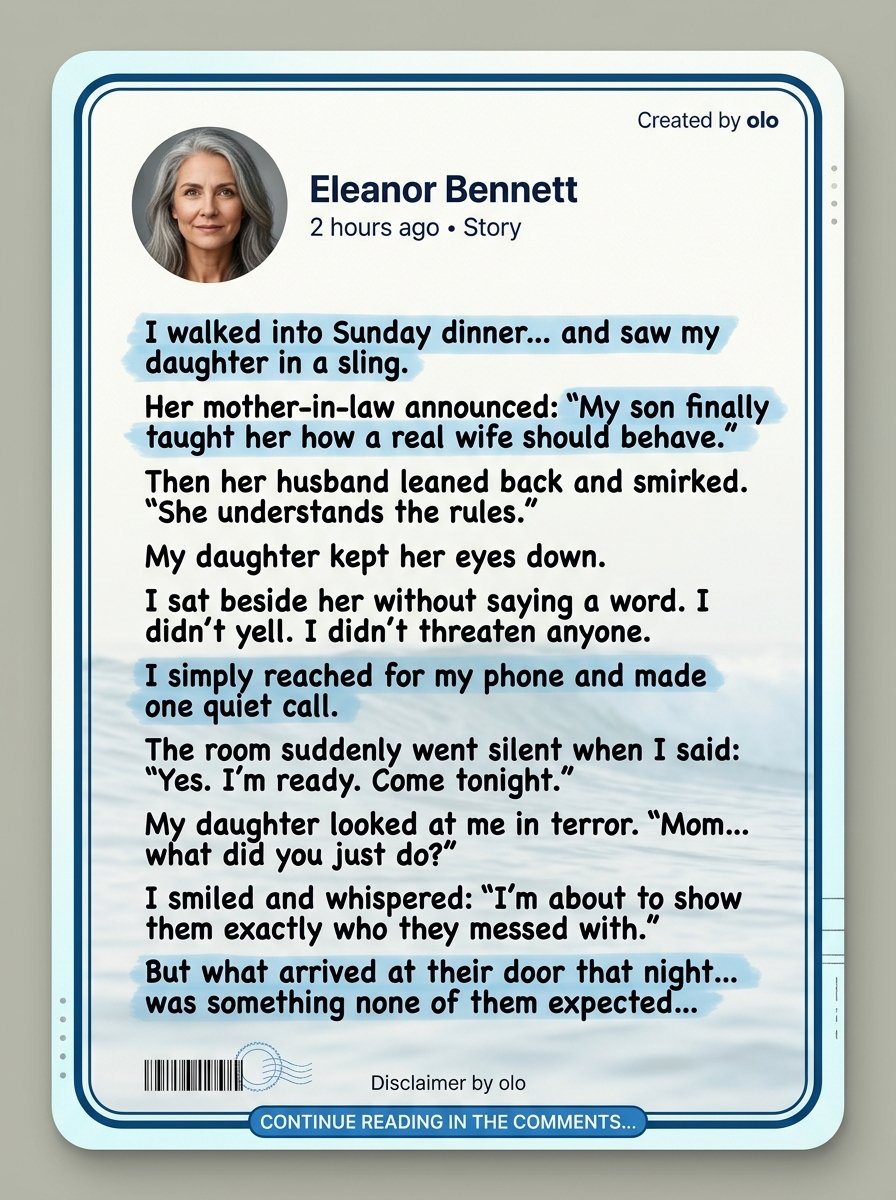
My daughter grabbed my hand beneath the dinner table.
“Mom, please,” she whispered. “Whatever you’re planning, don’t make things worse.”
I looked at her sling, then at the faint bruises disappearing beneath the sleeve of her dress.
“Sweetheart,” I said quietly, “how long has this been happening?”
She stared at her plate.
Her husband laughed.
“Oh, come on. Don’t turn this into a drama. She fell. It happens.”
His mother nodded approvingly.
“A wife should learn not to provoke her husband. Marriage requires discipline.”
I slowly turned toward her.
“Is that what you call it when a man hurts his wife?”
Her smile disappeared.
My son-in-law leaned forward. “You need to remember whose house you’re sitting in.”
I almost laughed.
He had absolutely no idea who he was speaking to.
For thirty years, I had worked as a senior attorney, handling cases involving domestic violence, financial abuse, and families who believed money and influence made them untouchable.
But tonight, I wasn’t sitting there as an attorney.
I was sitting there as a mother watching her daughter struggle to hide her pain.
And I was done pretending everything was fine.
I helped my daughter stand.
“We’re leaving,” I told her.
Her husband slammed his hand against the table.
“She isn’t going anywhere!”
My daughter flinched so violently that the room fell silent.
That single reaction told me more than any explanation could have.
I turned to him.
“You’ve mistaken her fear for obedience.”
He stood up, towering over us.
“Get out of my house before I call the police.”
I met his eyes.
“Please do.”
His expression changed.
I took my daughter outside, helped her into my car, and drove straight to the emergency department.
The doctor examined her shoulder and documented her injuries. When we were alone, I gently asked her to tell me the truth.
She cried for nearly twenty minutes.
Then she told me everything.
The threats. The humiliation. The money he controlled. The way his mother blamed her whenever he lost his temper.
And the incident that had left her arm in a sling.
“He said nobody would believe me,” she whispered. “He said his family knew important people.”
I held her hand.
“Listen to me. You don’t have to go back there tonight. You don’t have to protect him. And you don’t have to face this alone.”
Then I made the call I’d been preparing to make.
Not to threaten anyone.
Not to arrange revenge.
I called my attorney colleague and the domestic violence advocate who had helped me with cases for years. Together, we arranged a safe place for my daughter, discussed how to preserve evidence, and contacted the appropriate authorities.
The next call was to the police.
I gave them the information I had and asked how to report the assault properly.
Then I sent one message to my son-in-law.
Do not contact my daughter tonight. Any further threats will be documented and reported.
At 9:17 p.m., my phone rang.
It was him.
“You think you’ve won?” he snarled. “You have no idea what you’re dealing with.”
I didn’t argue.
I simply said, “Someone will be at your door tonight.”
He laughed.
“Who? Your lawyer?”
“No,” I replied. “Someone who needs to hear the truth.”
Then I hung up.
At 10:03 p.m., the doorbell at his house rang.
And when he opened the door, his smug expression vanished.
Because standing outside were two police officers, a court-appointed professional with documents concerning the next steps in the case, and a man he had spent years hoping would never learn what he’d done.
His own father.
And his father was holding a folder.
Inside it were records that would change everything.
PART 3: The Truth He Never Expected to Face
My son-in-law stared at his father.
“Dad? What are you doing here?”
His father didn’t answer immediately.
He looked past him into the house, where my son’s mother-in-law—my daughter’s mother-in-law—stood frozen near the dining table.
Then he looked at his son.
“Is it true?” he asked.
My son-in-law scoffed.
“Is what true?”
“That you hurt your wife.”
The laughter was gone now.
“She’s exaggerating. You know how emotional she gets.”
His father opened the folder.
“I know you’ve told people she injured herself. I know you’ve been telling your friends that her mother is trying to destroy your marriage.”
He paused.
“But I also know that the medical records, the messages, and the photographs tell a very different story.”
My son-in-law’s face drained of color.
His mother rushed forward.
“This is a private family matter! We can handle this ourselves.”
One of the officers spoke calmly.
“Ma’am, this is not something you get to dismiss simply because you consider it a family matter.”
For the first time that evening, nobody had an answer.
His father placed the folder on the table.
“I raised you to take responsibility for your actions,” he said. “I never taught you that being a husband gave you the right to frighten or hurt someone.”
My son-in-law shook his head.
“You’re taking her side over your own son?”
His father looked directly at him.
“I’m taking the side of the truth.”
Then he revealed something my son-in-law hadn’t expected.
Three weeks earlier, he’d received a message from my daughter.
She hadn’t accused anyone. She hadn’t demanded money. She had simply asked him whether he would be willing to speak privately.
He’d ignored it at first.
But after seeing her injuries and hearing what had happened, he had decided he could no longer pretend he knew nothing.
He had brought copies of messages his son had sent him, including one in which my son-in-law admitted that he had “lost control” during an argument.
It wasn’t the entire case, and it wasn’t a substitute for a proper investigation.
But it was another piece of evidence that could no longer be brushed aside.
My son-in-law turned toward his mother.
“Say something!”
She looked away.
For years, she had defended him, blamed my daughter, and called his behavior a husband’s right.
Now, with the officers standing in her living room, she suddenly seemed to have forgotten every speech she’d ever made about family loyalty.
The officers explained the next steps and spoke with those involved. My son-in-law was not allowed to intimidate my daughter into silence, and the allegations would be handled through the appropriate legal process.
That night, my daughter slept somewhere safe.
For the first time in months, she didn’t have to listen for footsteps in the hallway.
The following morning, she sat beside me at the kitchen table.
“Mom,” she whispered, “how did you know what to do?”
I reached for her good hand.
“Because asking for help isn’t weakness. And nobody gets to hurt you and then demand that you protect their reputation.”
She began to cry.
“I thought nobody would believe me.”
I pulled her close.
“I believe you.”
Over the following weeks, she worked with an advocate and her lawyer to make decisions about her safety, her marriage, and her future. The investigation continued, and the evidence was reviewed through the proper legal channels.
There were difficult days.
There were moments when she wondered whether she should have stayed quiet.
And there were moments when she missed the man she had believed she married.
Healing wasn’t a single dramatic night. It was a series of small decisions that gradually gave her back her confidence.
Months later, I accompanied her to a hearing.
She walked into the room without lowering her eyes.
Her arm had healed.
Her voice no longer trembled when she spoke.
And when she finally faced the people who had once told her to obey, she said something I will never forget:
“I was your wife. I was never your property.”
Nobody laughed.
Nobody smirked.
Nobody told her to lower her eyes.
Afterward, she squeezed my hand.
“Thank you for coming to get me, Mom.”
I smiled through my tears.
“You never needed to earn your way out of a situation that was hurting you. You only needed to know you had somewhere safe to go.”
That Sunday dinner had begun with a family pretending cruelty was tradition.
It ended with my daughter taking the first steps toward a life where fear would no longer make her decisions.
And as for the man who once smirked and said she understood the rules?
He finally learned the one rule that mattered:
Marriage does not give anyone ownership over another human being.
And a mother’s love doesn’t mean seeking revenge.
Sometimes, it means standing beside your child, telling the truth, and refusing to let anyone silence her again.
THE END.