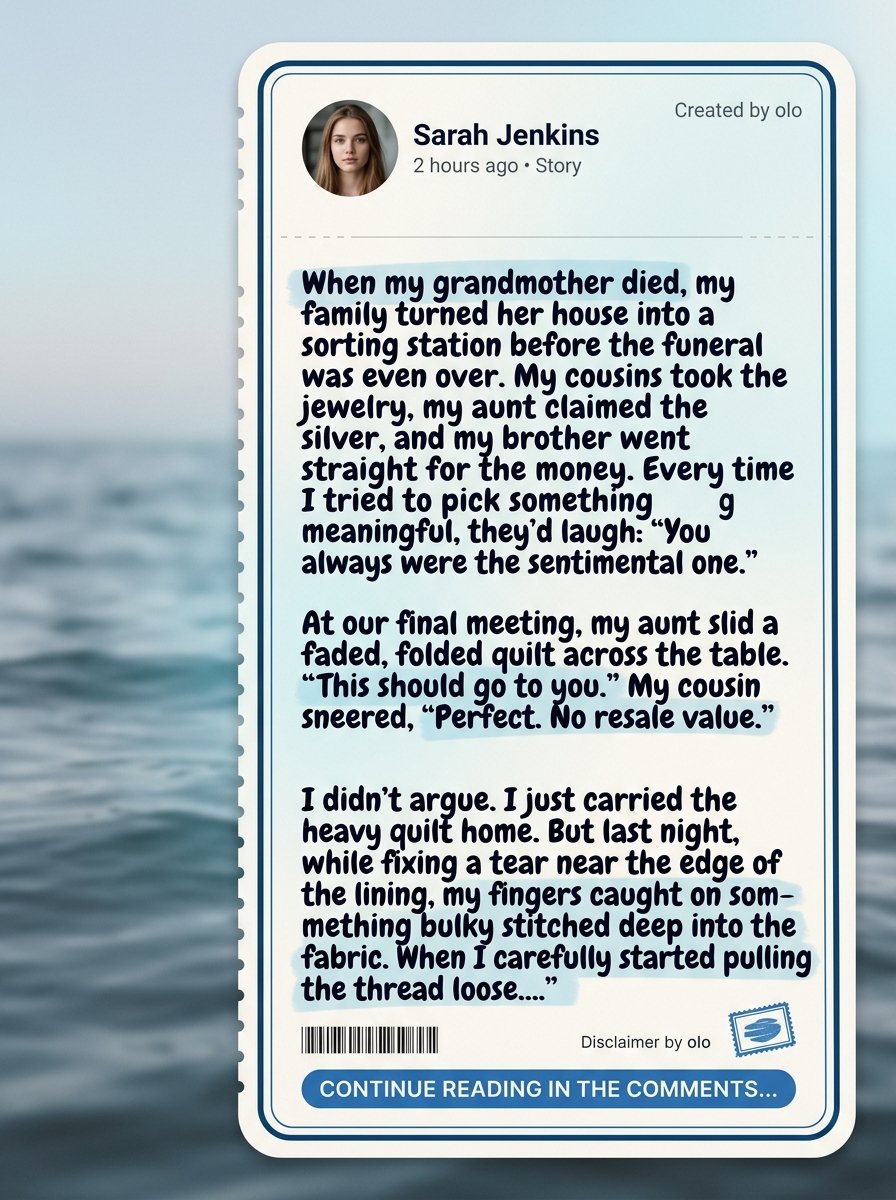
When I carefully started pulling the thread loose, a small envelope slipped out of the lining and landed on my living room floor.
At first, I thought it was just an old receipt.
The envelope was yellow with age, sealed with a strip of tape that had almost turned brown. My grandmother’s handwriting was written across the front.
“For my granddaughter. Open this when the others have taken everything.”
I sat there staring at those words.
My grandmother had known.
Somehow, she had known exactly what my family would do after she died.
My hands trembled as I opened the envelope. Inside was a folded letter, a small brass key, and a photograph of my grandmother standing beside a young woman I had never seen before.
On the back of the photograph, Grandma had written a date from nearly forty years earlier.
Beneath it were five words.
“The day I learned the truth.”
I unfolded the letter.
My dearest girl,
If you are reading this, then I am gone, and your family has probably already divided my belongings as though my life were nothing more than a collection of things with price tags.
I am sorry.
I should have told you this years ago, but I was afraid of what would happen when the truth came out.
I stopped reading.
My grandmother had always been the quietest person in our family. While my aunt argued over money and my brother complained about responsibilities, Grandma would sit beside me and ask about my day.
She remembered the little things.
My favorite tea. The name of my first childhood friend. The birthday I spent crying because nobody came to my school play.
She had never made me feel insignificant.
I continued reading.
Your grandfather did not leave this family as poor as everyone believes. There was money, but it was not the kind of money that appears in a bank statement.
Some of it was placed somewhere safe. Some was used to protect someone who had nowhere else to go.
And some belongs to a person your family has spent decades pretending never existed.
My heart began pounding.
I looked at the photograph again.
The young woman beside Grandma had dark hair and a small scar above her left eyebrow.
I turned the picture over.
On the back, beneath the date, was a name.
Eleanor Whitmore.
I had never heard that name before.
Not once in my entire life.
I read the letter again.
Eleanor was your grandfather’s daughter.
I dropped the paper.
My grandfather had died when I was little. My family always spoke of him as a hardworking man who had built everything from nothing. There had never been any mention of another daughter.
I picked up the letter with shaking fingers.
Your grandfather had a child before he met me. Eleanor was not a secret because he was ashamed of her. She was a secret because someone in this family made sure she could never come home.
I could barely breathe.
Who had done that?
And why had Grandma kept it hidden for so long?
The letter continued.
The brass key opens a small safe-deposit box. The bank and box number are written on the paper beneath this letter.
Inside, you will find the documents that prove what I am telling you.
I am leaving you the key because you were the only person in this family who ever asked me how I felt rather than what I owned.
Your aunt will tell you that the quilt is worthless. Your brother will tell you that I was confused in my final years. They may even tell you that I was never capable of making decisions for myself.
Do not believe them.
I was waiting for the right person to find this.
And I believe that person is you.
I read the letter three times.
Then I looked at the quilt.
The same quilt my cousin had laughed at.
The same quilt my aunt had pushed across the table as though she were throwing away a useless rag.
I suddenly noticed something else.
The stitching along the inside seam was different from the rest. It was newer, neater, and deliberately hidden.
I carefully examined the lining.
There were more envelopes sewn inside.
Six of them.
Each contained a different document.
The first was a copy of a property deed.
The second was a bank statement.
The third was a letter from an attorney.
And the fourth was a document bearing my grandfather’s signature.
It stated that a substantial portion of his estate had been placed in a trust decades earlier.
The beneficiary?
Eleanor Whitmore.
But there was a handwritten note attached to the document.
If Eleanor cannot be found, the trust must remain untouched until her descendants are located.
I sat motionless.
My family had spent the entire evening arguing over silverware, jewelry, and furniture.
Meanwhile, Grandma had hidden the most important part of her story inside a quilt they considered worthless.
I picked up my phone and called the bank listed on the paper.
After several minutes, a representative confirmed that the safe-deposit box still existed.
But when I asked what was inside, she explained that I would need to visit the branch in person and provide identification.
I made an appointment for the following morning.
Then my phone rang.
It was my brother.
“Hey,” he said casually. “You still have that old quilt?”
I glanced at the open envelopes on my coffee table.
“Why?”
“Mom’s sister thinks there might be something valuable in the lining. Some antique collectors pay for old fabric.”
It was the first time all day that anyone in my family had shown interest in the quilt.
I said nothing.
My brother cleared his throat.
“Listen, bring it over tomorrow. We’ll have someone look at it.”
I tightened my grip on the phone.
“No.”
Silence.
“What do you mean, no?”
“I mean it’s mine.”
He laughed.
“Don’t be ridiculous. It’s an old blanket.”
“Then why do you suddenly want it?”
His tone changed.
“Because we’re family. We should be able to share things.”
I almost laughed.
Share things?
They had taken Grandma’s jewelry before the funeral flowers had wilted. They had divided her belongings while I was still trying to process that she was gone.
And now, suddenly, we were family.
“I’ll call you later,” I said.
I hung up.
Then I turned back to the photograph of Eleanor.
For the first time, I noticed a tiny detail in the background.
The young woman was standing in front of a house.
A large white house with a stone wall and a distinctive iron gate.
I recognized it.
It was the house my grandmother had driven past every Sunday when I was a child.
Whenever I asked whose house it was, she would simply say, “Someone who should have been family.”
I had always thought she was talking about an old friend.
Now I wondered whether she had been trying to tell me something.
I placed the photograph in my bag, along with the key.
Tomorrow, I would visit the bank.
And I would find out what my grandmother had spent decades trying to protect.
But I had no idea that my brother had already called my aunt.
And that they were both planning to visit my house before sunrise.
# PART 3: The Inheritance Nobody Knew Existed
At nine the next morning, I walked into the bank carrying Grandma’s letter in my handbag.
I hadn’t slept.
Every time I closed my eyes, I saw the photograph of Eleanor and the words written on the back.
The day I learned the truth.
A bank employee escorted me into a private room and checked my identification.
After verifying the paperwork, she brought out a small metal box.
The brass key fit perfectly.
Inside were several folders, a sealed envelope, and a small leather notebook.
I opened the first folder.
It contained old property records, legal correspondence, and financial documents dating back decades.
I didn’t understand every detail, but one thing was immediately clear.
My grandfather had owned a significant amount of property.
Some had been sold years earlier. Some had been transferred into a trust.
And one property remained in the trust’s name.
The white house.
The house behind the iron gate.
The house my grandmother had passed every Sunday.
I turned to the legal documents.
The trust had been established to provide for Eleanor and her descendants.
But there was a condition.
If Eleanor had died without children, the remaining assets would pass to another named beneficiary.
I read the name twice.
It was mine.
Not my brother’s.
Not my aunt’s.
Mine.
I felt dizzy.
A separate letter from the attorney explained that Grandma had been appointed the trust’s administrator after my grandfather died. She had maintained the records and paid the necessary expenses for years.
But she had never transferred the assets to herself.
She had protected them until Eleanor or her descendants could be found.
I reached for the leather notebook.
Inside were pages of names, dates, addresses, and handwritten notes.
Most were difficult to decipher.
Then I found an entry dated twenty-seven years earlier.
Eleanor called today. She has a daughter. She says the girl is kind, but she doesn’t want her to know about the family money until she is old enough to understand what it means.
A few pages later, another entry appeared.
Eleanor’s daughter has a little girl of her own. They are doing well. I saw them from across the street today. I wanted to introduce myself, but I couldn’t find the courage.
I stopped reading.
Grandma had known Eleanor’s family.
She had seen them.
She had been close enough to speak to them, yet she had stayed away.
Why?
I turned to the final page.
If I am no longer here when the truth is discovered, I hope someone in this family will finally understand that love is not measured by what we inherit.
I am leaving the decision to you.
Find Eleanor’s daughter. Tell her the truth. Give her the choice I never had the courage to offer.
At the bottom was an address.
The same address as the white house.
I left the bank and drove north.
The journey took nearly two hours.
The closer I got, the more familiar the landscape became. I remembered riding in Grandma’s old car, watching trees pass the windows as she hummed along to the radio.
When I reached the house, I parked across the street.
For several minutes, I simply sat there.
Then the front door opened.
An elderly woman stepped onto the porch.
She had silver hair, a walking stick, and the same small scar above her left eyebrow as the young woman in the photograph.
My heart stopped.
It was Eleanor.
I crossed the street slowly.
“Excuse me,” I called.
She looked up.
“Can I help you?”
I held out the photograph.
Her expression changed the instant she saw it.
She gripped the railing.
“Where did you get that?”
“My grandmother kept it.”
“Who was your grandmother?”
I told her.
For a long moment, Eleanor said nothing.
Then she sat down on the porch steps and began to cry.
“Margaret,” she whispered. “I wondered whether she’d ever tell anyone.”
I sat beside her.
“I’m sorry. I don’t understand any of this.”
Eleanor wiped her eyes.
“Your grandfather was my father. When he died, I was told that his estate had been settled and that there was nothing left for me. I believed it for years.”
“Who told you that?”
She looked at me.
“Your aunt.”
My stomach tightened.
“My aunt?”
“She was very young at the time, but she was already involved in the family business. She told me that your grandmother wanted nothing to do with me. She said I would only cause trouble if I tried to return.”
I shook my head.
“Grandma never said anything like that.”
“I know that now,” Eleanor replied. “Margaret came to see me once, many years later. She stood across the street and watched me through the window. By the time I went outside, she was gone.”
My throat tightened.
“She regretted it every day.”
Eleanor looked at the photograph again.
“Did she leave you something?”
I nodded.
“A quilt. And some documents.”
She closed her eyes.
“Then she finally found a way to tell the truth.”
We sat together for nearly an hour.
She told me about her childhood, her father, and the years she had spent believing she had been abandoned by the family.
I told her about Grandma’s final days and how the others had divided her belongings.
When I mentioned the quilt, Eleanor gave a sad smile.
“Your grandmother made that quilt for me when I was a little girl. I thought it had been lost forever.”
I felt tears rise in my eyes.
“She left it to me.”
“Then she wanted you to have it.”
Before I left, Eleanor gave me an old family photograph.
It showed my grandfather, my grandmother, Eleanor, and a young girl standing in front of the white house.
On the back, Grandma had written:
Family is not the people who claim what you leave behind. It is the people who remember who you were.
I drove home with the photograph beside me.
But when I arrived, I found my brother and aunt waiting in my living room.
The quilt lay on the coffee table.
Its lining had been torn open.
My aunt stood up.
“Where have you been?”
I stared at the damaged fabric.
“How did you get into my house?”
My brother looked away.
“We have a right to know what’s going on.”
“No,” I replied. “You don’t.”
My aunt crossed her arms.
“Your grandmother was confused near the end. Whatever she wrote down, whatever she promised you, it doesn’t mean anything if she wasn’t thinking clearly.”
I placed the trust documents on the table.
“Then explain this.”
Her face drained of color.
My brother picked up the first page.
He read the name of the trust.
Then he looked at me.
“What is this?”
I answered quietly.
“Grandpa’s estate. The part of the family you never told me existed.”
My aunt reached for the papers, but I pulled them away.
“I met Eleanor yesterday.”
For the first time in my life, I saw my aunt speechless.
She sank into a chair.
My brother stared at her.
“You knew?”
She didn’t answer.
“You knew there was another daughter?” he demanded.
My aunt covered her face.
“I was trying to protect the family.”
“From what?” I asked. “The truth?”
She finally looked at me.
“Your grandfather left debts. We were afraid everything would be lost. I thought if Eleanor stayed away, we could keep the estate together.”
“But Grandma kept the records. She protected the trust. She never took what wasn’t hers.”
My aunt began to cry.
“I know.”
I looked at the torn quilt.
“You took the jewelry. The silver. The things you thought were worth money. And you left me the one thing you thought was worthless.”
Nobody spoke.
I gathered the quilt into my arms.
“I don’t want revenge,” I said. “I want the truth recorded properly. I want Eleanor to know what belonged to her. And I want the family to stop pretending that money matters more than people.”
My brother lowered his head.
For once, he had nothing clever to say.
Over the following months, the attorney reviewed the trust and its history. Eleanor received independent legal advice, and the documents were handled through the proper legal process.
Not every relationship was repaired.
My aunt never fully admitted what she had done. My brother apologized, although it took him a long time to understand why his apology couldn’t erase everything.
But Eleanor and I stayed in touch.
We began having Sunday lunches together, just as Grandma had once done with me.
One afternoon, she brought a box of old photographs to my house.
Inside was a picture of Grandma sitting at a sewing machine, making the quilt.
On the back, in faded ink, were the words:
For the one who sees the person, not the price.
I had the quilt repaired by a local seamstress, preserving every original piece of fabric and the hidden pocket where Grandma had placed her letters.
I didn’t sell it.
I didn’t put it away in a cupboard.
I draped it over the back of my couch, where I could see it every day.
Because my family had been right about one thing.
The quilt had no resale value that could compare with the money in the trust.
But they had been wrong about everything else.
The most valuable thing my grandmother left me wasn’t the inheritance. It was the truth she trusted me to carry.
And every time I look at that quilt, I remember her final lesson:
When people divide a life into things they can take, pay attention to the things they leave behind.
THE END.