 Writing
“You need to come over immediately,” she said. “Your father and I have something to show you.”
I could hear the nervousness beneath her anger, but I wasn’t about to play by her rules anymore.
“I’ll meet you at your house,” I replied.
“We don’t have a house anymore!” she snapped.
“That sounds like something you should have thought about before demanding mine.”
She went silent.
Then she said something that confirmed my suspicions.
“You have no idea what your father has done.”
I looked at the envelope sitting on my desk.
“Oh, Mom,” I said quietly. “I think I know more than you realize.”
That morning, my lawyer had called me with an update. The documents my parents had presented during their visit three months earlier weren’t ordinary paperwork. Among them was a draft agreement that would have transferred ownership of my property to them.
The most disturbing part was that the paperwork contained information about my mortgage, my property value, and my financial situation that I had never given them.
Someone had been digging into my affairs.
My lawyer advised me not to confront them without a witness and reminded me not to sign anything they presented. She also helped me document the incident in which my father had hit me.
But that wasn’t the only thing I’d discovered.
A few weeks earlier, Jessica had accidentally sent me a message intended for our mother.
It read:
Did Dad tell her about the loan yet? We need her signature before the bank calls again.
I stared at those words for nearly a minute.
What loan?
And why did they need my signature?
I replied, pretending I didn’t understand.
What loan are you talking about?
Jessica immediately deleted her message, but I’d already seen it.
She never answered my question.
Instead, I contacted my lawyer and explained everything. She told me not to jump to conclusions, but she agreed that the message deserved attention.
We began looking into the paperwork my parents had tried to get me to sign.
That was when the pieces started coming together.
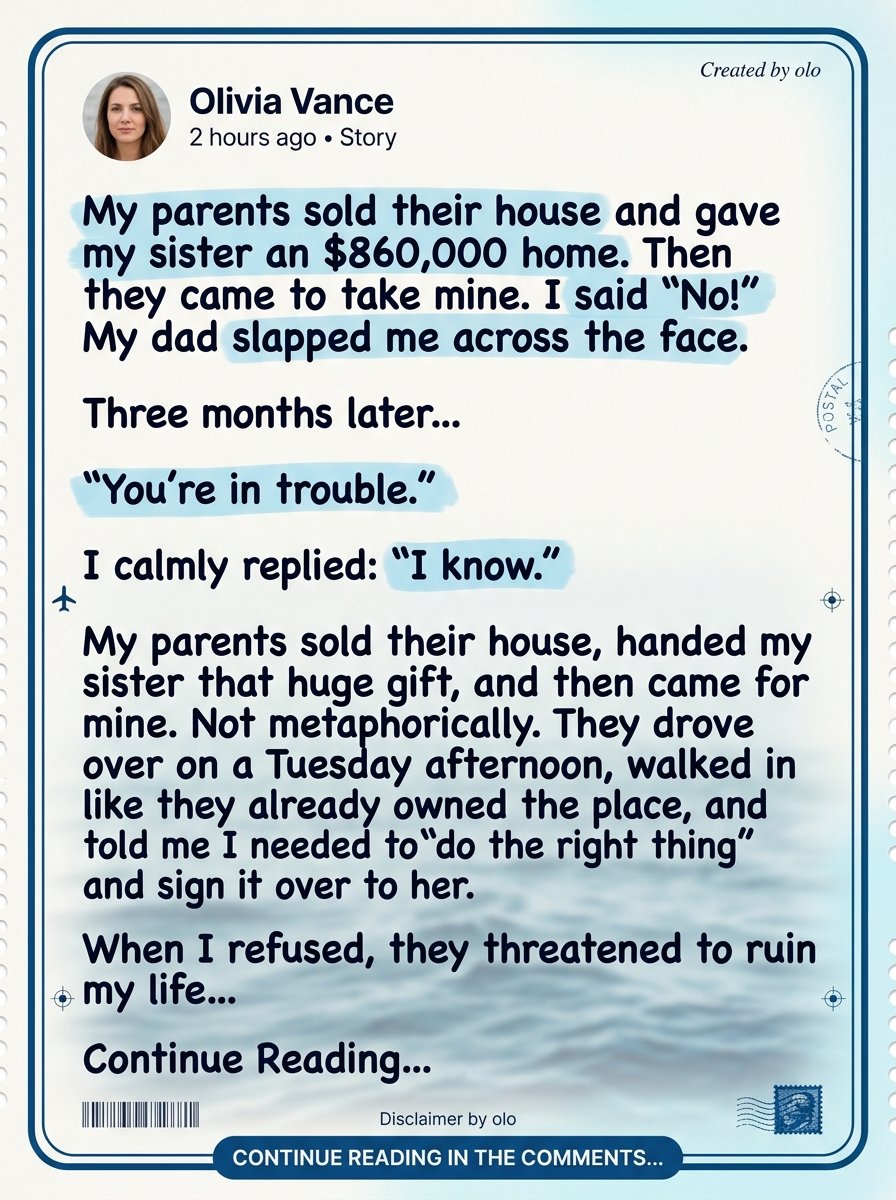
My parents had sold their house and used the money to purchase Jessica’s $860,000 home. But the transaction had apparently left them with financial obligations they hadn’t expected. Jessica and her husband had also been struggling with debts of their own.
Somehow, my parents had come to believe that my house could solve their problems.
I didn’t yet know exactly what they had planned, but I knew one thing: I wasn’t going to let anyone use my property to cover debts I hadn’t agreed to take on.
So when my mother called again, I agreed to meet them—but only at my lawyer’s office.
She objected immediately.
“Why do we need a lawyer? We’re family!”
“Because the last time we talked about my house, Dad hit me.”
There was a long silence.
Then she whispered, “You are still holding that against him?”
I closed my eyes.
That was my mother. Even now, she wasn’t worried about what he’d done. She was worried that I wouldn’t pretend it hadn’t happened.
“Yes,” I answered. “I am.”
She hung up.
Two hours later, my father called.
His voice was unusually controlled.
“We need to settle this like adults,” he said. “Your mother is upset, and your sister is in a difficult position.”
“Then tell me what the loan has to do with my house.”
Silence.
I heard him take a sharp breath.
“What loan?”
I almost smiled.
“That’s what I was hoping you’d explain.”
He ended the call.
That evening, Jessica finally contacted me.
For once, she didn’t sound angry or entitled.
She sounded frightened.
“Please don’t do anything until you hear our side,” she said.
“I’m listening.”
She hesitated.
“Dad said the paperwork was just a formality. He told us you would eventually agree to help.”
“Help with what, Jessica?”
She began crying.
And then she told me something I hadn’t expected.
My parents hadn’t simply hoped I would give them my house.
They had been making plans involving it for weeks.
And my signature was the one thing they still needed.
PART 3: The Secret My Family Tried to Hide
The following morning, I met my lawyer before speaking to my family again.
I told her everything Jessica had said, including the message about the loan.
My lawyer listened carefully and asked me to forward the message if I still had a screenshot. Fortunately, I did.
“Do not sign anything,” she told me. “And do not agree to any financial arrangement until we understand exactly what they’re asking you to do.”
I promised I wouldn’t.
Later that afternoon, Jessica arrived at my house.
I nearly refused to let her in, but she looked so exhausted that I decided to hear her out.
She sat on my sofa, twisting her hands together.
“Dad said you were being unreasonable,” she began. “He said you had plenty of money and that helping us wouldn’t hurt you.”
“Helping you how?”
She looked down.
“My husband and I borrowed money. More than we could comfortably repay. Dad said he could fix everything if we worked together.”
I waited.
“After they bought me the house, we still had expenses. Renovations, furniture, some other debts. Things got out of control.”
“So you went to our parents for more money?”
She nodded.
“They said they could help if you agreed to transfer your house to them.”
I stared at her.
“Why would transferring my house to them solve your debts?”
“Dad said they could use the property to secure financing.”
There it was.
They had been hoping to use my property as leverage for a financial arrangement without my freely given agreement.
I felt sick.
“Did you know they were going to pressure me into signing?”
Jessica started crying again.
“I knew they wanted you to help. I didn’t know Dad was going to hit you.”
“But you knew about the plan.”
She didn’t answer.
That silence hurt more than I expected.
For years, I’d told myself Jessica was simply spoiled. I had tried to maintain a relationship with her despite the unequal treatment, hoping that one day she’d recognize how much our parents favored her.
Now I realized that she had been willing to benefit from that favoritism even when it meant putting my home at risk.
“I need you to understand something,” I told her. “Your financial problems are not my responsibility. I didn’t choose your debts, and I never agreed to put my house up as security for them.”
“I know.”
“Do you? Because nobody in this family seems to understand that my answer can be no.”
She wiped her face.
“What are you going to do?”
“Protect my home.”
The next day, my lawyer sent a formal letter to my parents stating that I had not authorized any transfer of ownership or use of my property as security for their obligations. She instructed them to stop pressuring me to sign documents and requested clarification about the paperwork they had presented.
We also took steps to document the incident involving my father and preserve the evidence we had.
My parents responded with anger.
Mom called me selfish. Dad left a voicemail accusing me of destroying the family. Several relatives sent messages saying I should forgive him and help my sister because family was more important than money.
I didn’t respond to any of them.
Then came the meeting.
My parents arrived at my lawyer’s office with Jessica and a folder full of documents. Dad looked furious. Mom looked exhausted. Jessica wouldn’t meet my eyes.
My lawyer began by asking them to explain what they wanted me to sign.
Dad cleared his throat.
“We simply want to find a reasonable solution for everyone.”
“Then explain the proposed transfer,” my lawyer replied.
He shuffled the papers.
“We thought it would be best for the family if the property were placed under our control temporarily.”
“Temporarily?” I asked. “Where does the agreement say that?”
He didn’t answer.
My lawyer turned to the relevant pages and asked why the document would transfer ownership rather than establish a temporary arrangement.
Dad’s face reddened.
“You’re making this much more complicated than it needs to be.”
“No,” I said. “I’m finally taking it seriously.”
Mom leaned toward me.
“Your father made a mistake when he hit you. We’ve all moved past that. Why can’t you?”
I looked directly at her.
“Because you never apologized. You blamed me for it. And now you’re asking me to hand over my home as if nothing happened.”
For the first time, she had no immediate answer.
My lawyer then asked whether anyone had represented to a lender or another party that I had agreed to the proposed arrangement.
The room became completely silent.
Dad looked at Mom.
Mom looked at Jessica.
And Jessica began to cry.
I realized then that there was still something they hadn’t told me.
My lawyer asked the question again.
“Has anyone represented that the homeowner has agreed to this transfer or to using the property as security?”
Dad finally spoke.
“We were trying to arrange things before the situation got worse.”
“That doesn’t answer the question,” my lawyer replied.
He stared at the table.
My lawyer explained that any claim that I had consented would need to be addressed with proper documentation and that no one should assume they could use my property without my authorization.
I didn’t need to shout. I didn’t need to threaten anyone.
For the first time in my life, I didn’t have to defend my right to say no by making my family understand my feelings.
I simply had to maintain my boundary.
The meeting ended without an agreement.
My parents left furious. Jessica lingered in the hallway.
“I’m sorry,” she whispered.
I looked at her for a long moment.
“I hope you mean that,” I said. “But an apology doesn’t mean I’ll put myself at risk for you.”
She nodded and walked away.
In the weeks that followed, I continued working with my lawyer to protect my property and clarify the situation. I refused to sign anything I didn’t fully understand, and I stopped taking calls from relatives who wanted me to sacrifice my security to preserve the family’s image.
Eventually, my mother sent me a message.
Your father says you have turned against your own family.
I read it twice before replying.
I haven’t turned against anyone. I’ve simply stopped allowing you to treat my life as something you own.
She never answered.
My father never offered a real apology. Jessica and I barely spoke after that, although I hope one day she’ll learn to take responsibility for her own choices.
As for me, I kept my house.
I kept making my mortgage payments, fixing what needed fixing, and building a life that belonged to me.
The biggest lesson wasn’t about money, property, or even favoritism.
It was that people can call you selfish when they can no longer benefit from your silence.
And sometimes, the most important word you can say to your family is the one they have spent your entire life teaching you not to say.
No.