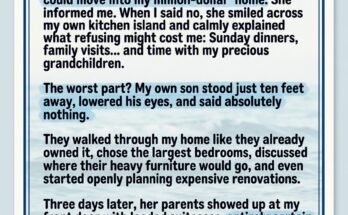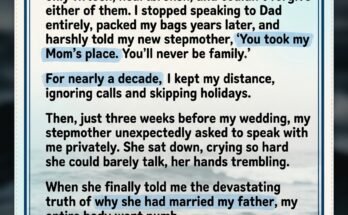
My son called me at 8:17 that morning.
His voice was shaking.
“Mom, what is this letter? It says the house is no longer yours to sell or transfer without a trustee’s approval. And what does it mean that you’ve changed your will?”
I took a slow sip of coffee.
“It means you should read the whole letter before calling me.”
He went silent.
For years, my son and his wife had treated my age like a countdown. Every time they visited, they pointed out the stairs, the garden, the bills, and the things I supposedly couldn’t manage anymore.
They never asked whether I was happy.
They only asked how much longer I planned to live alone.
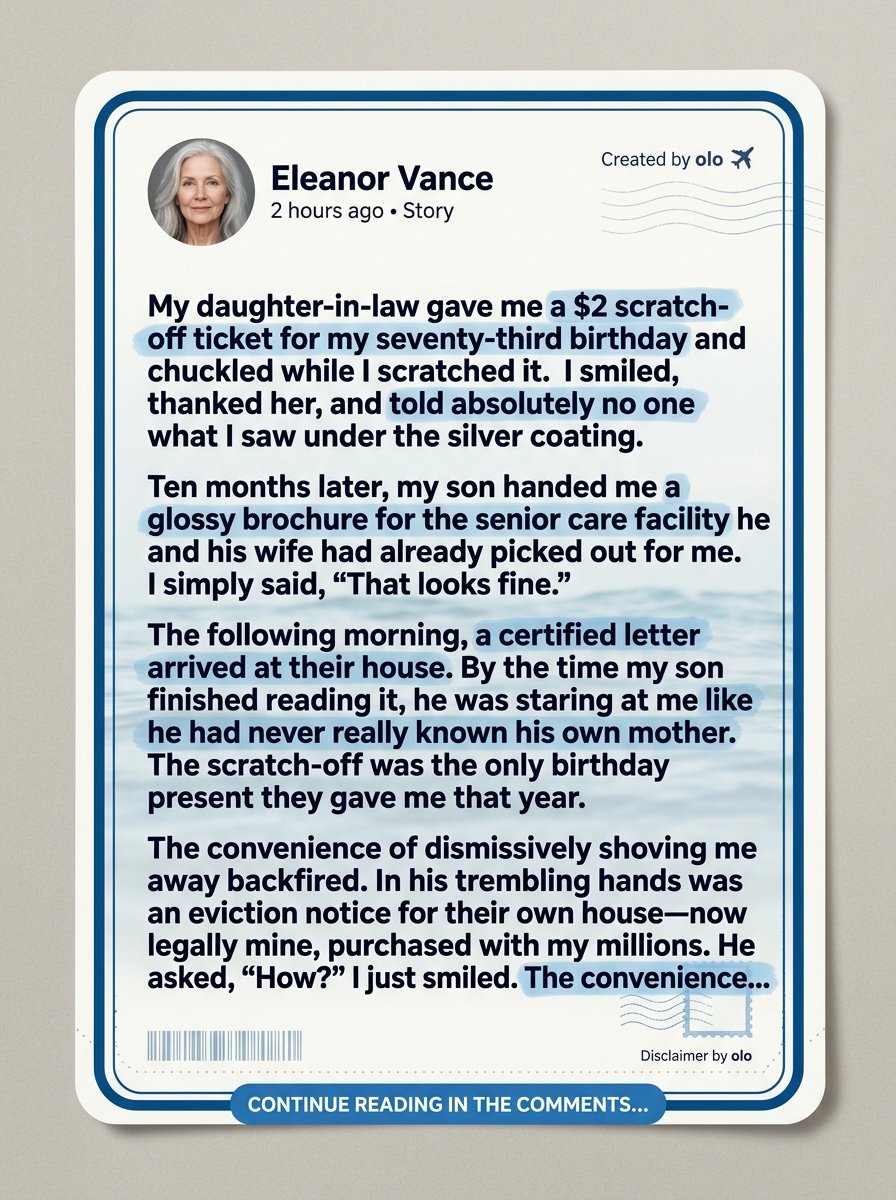
That birthday, when my daughter-in-law handed me that $2 scratch-off ticket, she whispered, “Maybe you’ll win enough to pay for your own nursing home.”
She thought it was hilarious.
I didn’t laugh.
But I did learn something that day.
They weren’t worried about my future.
They were planning it without me.
So I made a few calls to my attorney. I reviewed every document, every account, and every legal right I had. The house I’d spent forty-two years paying for would remain under my control. My medical decisions would remain mine. And my estate would be handled according to my wishes, not my son’s expectations.
The certified letter explained it all.
But there was one more document inside.
A copy of the letter I’d written to my son the night of my birthday.
He called again.
“Mom, why didn’t you tell me you felt this way?”
I stared out at the garden my late husband and I had planted together.
“Because, sweetheart,” I replied, “you never asked how I felt. You only asked when I’d be ready to leave.”
He had no answer.
Then he asked the question I’d been waiting for.
“Does this mean we’re not getting the house?”
I closed my eyes.
There it was.
Not Are you okay, Mom?
Not Can we talk about what happened?
Just the house.
And for the first time in my life, I stopped protecting him from the truth.
“Come over tomorrow,” I said. “There’s something you need to understand.”
Part 3: The Final Lesson
My son arrived the following afternoon alone.
His wife stayed home.
He sat at my kitchen table, the same table where I’d helped him with homework, celebrated his first job, and cried with him after his father died.
For a moment, I saw the little boy he used to be.
Then he opened his mouth.
“Mom, we were only trying to make things easier for you.”
I nodded toward the chair across from me.
“Then sit down and listen.”
I told him about the scratch-off ticket.
Not because I had won a fortune. I hadn’t.
I’d won nothing at all.
But when I scratched away the silver coating, I realized the ticket wasn’t the worst part of that birthday.
The worst part was watching my own family laugh while imagining my life becoming an inconvenience.
“I didn’t need an expensive gift,” I told him. “I needed to feel like your mother, not a problem you were trying to solve.”
He lowered his head.
I explained that I’d updated my legal documents, established clear instructions for my future care, and arranged my finances so that no one could pressure me into giving up my independence. My attorney had helped me make sure my wishes were documented properly.
The house would not be handed over as an advance inheritance.
My money would not be used to purchase my silence.
And no one would choose a care facility for me without my consent, unless the law provided otherwise in a genuine emergency.
My son wiped his eyes.
“Can you forgive me?”
I looked at him for a long time.
“Forgiveness isn’t a key that opens every door back to the way things were,” I said. “If you want a place in my life, you’ll have to show me that you want me in it.”
He nodded.
For the first time in months, he asked what I wanted.
I told him I wanted to keep living in my home while I could safely do so. I wanted to tend my roses, meet my friends for lunch, and spend my mornings reading in the sunlight.
I wanted to grow older without being made to feel guilty for it.
And I wanted my son to visit because he loved me, not because he was checking on an inheritance.
He left that evening without asking about the house again.
His wife eventually called, too. Her apology took longer, and I didn’t pretend that one conversation could erase everything she’d said or done. I told her we could start again, but only with honesty and respect.
Months passed.
Some things improved. Others took time.
I never moved into the facility they had chosen for me. Instead, I arranged the support I needed on my own terms, with professionals I trusted and decisions I made myself.
On my seventy-fourth birthday, my son came to visit.
He brought flowers, a cake, and a handwritten card.
There was no scratch-off ticket.
Inside the card, he had written:
“Mom, I’m sorry I made you feel like your life was something I had to manage instead of something I should cherish. I hope I can earn back your trust.”
I hugged him.
Not because everything was fixed.
But because he had finally begun to understand.
That evening, I sat in my garden, surrounded by the flowers my husband and I had planted decades earlier.
I thought about how easily people mistake kindness for weakness, and age for helplessness.
I was seventy-four years old.
I wasn’t finished living.
I wasn’t waiting for permission.
And I wasn’t going anywhere simply because someone else had decided my time was up.
The greatest gift I gave myself that year wasn’t money, a new will, or a locked bank account.
It was the realization that I could love my family without surrendering my dignity.
And if there’s one thing I want every older person to remember, it’s this:
You can forgive your children without handing them control of your life. You can love them without giving away your independence. And you can be a good parent without making yourself smaller to keep them comfortable.
Because growing older should never mean becoming invisible.
And your life remains yours, no matter how many birthdays you’ve celebrated.