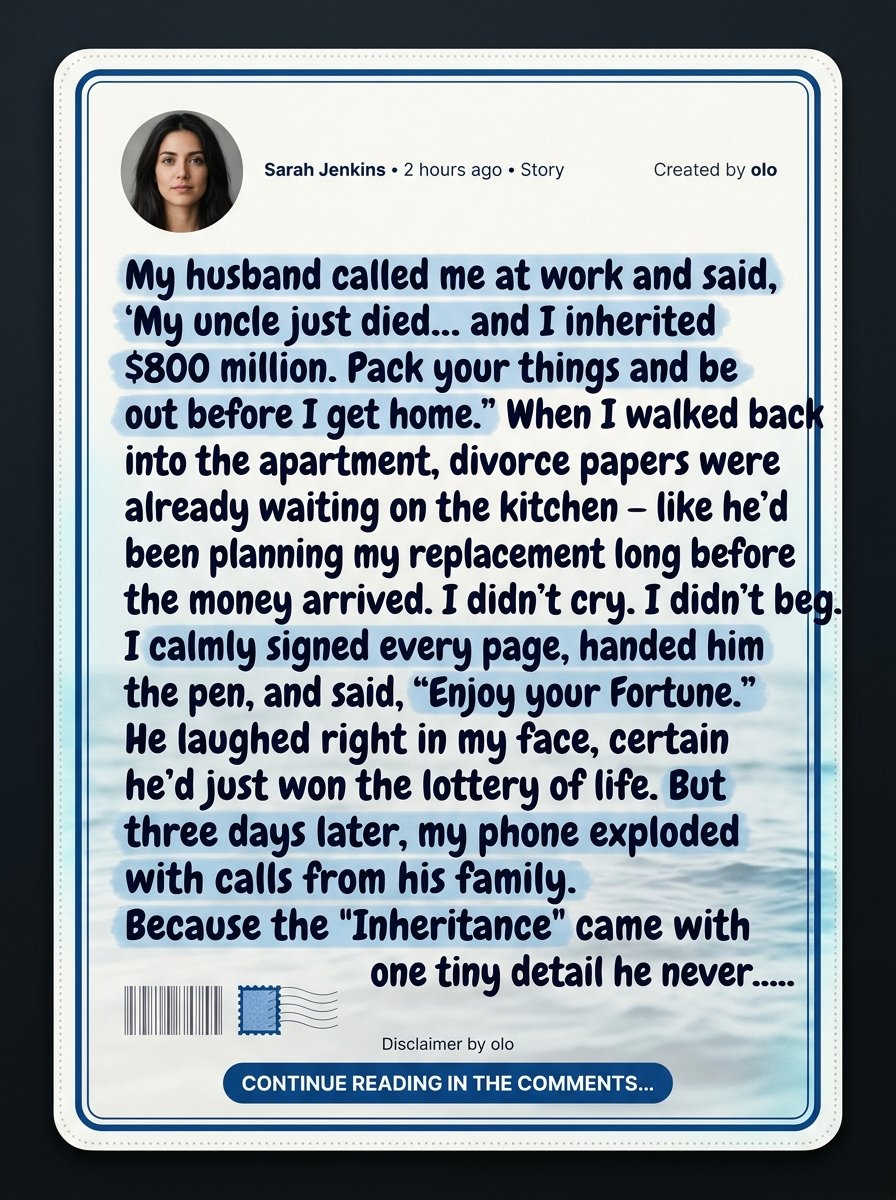
Three days after I signed the divorce papers, my phone wouldn’t stop ringing.
First, it was my mother-in-law.
Then his brother.
Then his aunt, who hadn’t spoken to me in almost two years.
I ignored every call until a message appeared from my husband’s number.
“Please pick up. We need to talk. It’s an emergency.”
I almost laughed.
Three days earlier, he’d looked me in the eyes and told me to get out of our home because he was suddenly worth $800 million.
Now he needed me?
I answered the next call.
His voice sounded nothing like the confident man who had thrown me away.
“Where are you?” he demanded.
“Somewhere I don’t have to listen to you.”
“Listen, I made a mistake. Things aren’t what I thought they were.”
I leaned against the window of my small hotel room.
“What happened to your $800 million?”
He went silent.
Then he whispered, “The inheritance comes with conditions.”
I said nothing.
Apparently, his uncle had left behind a fortune, but the will contained a clause that required my husband to meet specific obligations before he could receive the money.
And there was another problem.
His uncle had known about our marriage.
He had known that I stood beside my husband when he lost his job, when his business failed, and when his own family refused to help him.
According to the attorney, the uncle had privately investigated my husband’s character for years.
And the final document contained one sentence that changed everything:
“If my nephew divorces his wife solely to secure a life of wealth without her, the inheritance shall be transferred to the next named beneficiary.”
My husband had filed for divorce before the inheritance was even finalized.
He thought he was getting rid of the one person who could share his fortune.
Instead, he’d triggered the clause that could cost him everything.
“Please,” he said over the phone. “You have to help me fix this.”
I closed my eyes.
“Help you do what? You told me to leave before you got home.”
“I was excited. I wasn’t thinking clearly.”
“No,” I replied. “You were thinking very clearly. You just thought I was worth less than your money.”
Then I hung up.
But the next morning, an attorney called me with information that made my hands tremble.
The will had named a backup beneficiary.
And it wasn’t his brother.
It wasn’t his mother.
It wasn’t even another relative.
It was me.
PART 3: THE WOMAN HE THREW AWAY
I sat across from the attorney, staring at the documents in front of me.
“Are you telling me his uncle left the money to me?”
“Not exactly,” she explained. “Your husband’s inheritance was conditional. However, his uncle established a separate trust in your name, with provisions that become effective if your husband violates the terms of his inheritance.”
I swallowed hard.
“Why would his uncle do that?”
She opened another folder.
Inside was a handwritten letter.
The letter began:
“Dear Eleanor, if you’re reading this, then I’m afraid my suspicions about my nephew were correct.”
I had met my husband’s uncle only twice.
He had been a quiet, observant man who asked more questions than he answered.
The letter explained that he’d watched his nephew become increasingly obsessed with wealth, status, and the people he believed were beneath him.
He had also noticed how I treated my husband when there was nothing to gain.
The final paragraph read:
“I cannot choose the kind of man my nephew becomes. But I can choose what happens to the fortune I worked my entire life to build. If he abandons the person who stood beside him when he had nothing, he will not be rewarded for that betrayal. Eleanor, you will have the opportunity to protect a portion of this estate and decide how it should be used.”
The attorney explained that the trust contained $50 million, subject to its legal terms and administration.
I didn’t feel victorious.
I felt strangely sad.
Because I would have traded every dollar to have the husband I thought I married.
But that man had disappeared long before the inheritance arrived.
Two weeks later, we met in the attorney’s office to finalize the next steps in the divorce.
My husband looked exhausted.
His expensive suit was wrinkled, and the arrogance I’d known for years had been replaced by desperation.
“Eleanor,” he said, reaching for my hand. “We can start over. I’ll cancel the divorce. We’ll work through this together.”
I gently pulled my hand away.
“Would you still want me if the trust didn’t exist?”
He opened his mouth.
Nothing came out.
That silence told me everything I needed to know.
I signed the final documents.
Then I stood, picked up my purse, and looked him in the eyes.
“You didn’t lose me when your uncle died. You lost me when you decided I was disposable.”
He started crying.
For the first time, I couldn’t tell whether he was grieving our marriage or the fortune slipping away.
And honestly, it no longer mattered.
Months later, I used part of my trust to establish a foundation that helped women rebuild their lives after financial abuse and sudden divorce.
I bought a modest house, returned to the career I’d put on hold for him, and slowly rediscovered the woman I’d been before my marriage became a prison.
One evening, a letter arrived from my ex-husband.
It contained just four sentences.
“I thought money would make me powerful. Instead, it showed me exactly who I was. I know you may never forgive me. I only wish I’d understood your worth before I lost you.”
I read it once.
Then I placed it in a drawer and went back to my life.
Because here’s what I finally understood:
The greatest inheritance wasn’t the money his uncle left behind. It was the freedom to walk away from someone who only valued me when he thought I was valuable to him.
And the man who once laughed as I signed away our marriage?
He spent the rest of his life remembering the woman he had thrown away.
Not because she became rich.
But because she never needed his fortune to know her worth.
THE END.