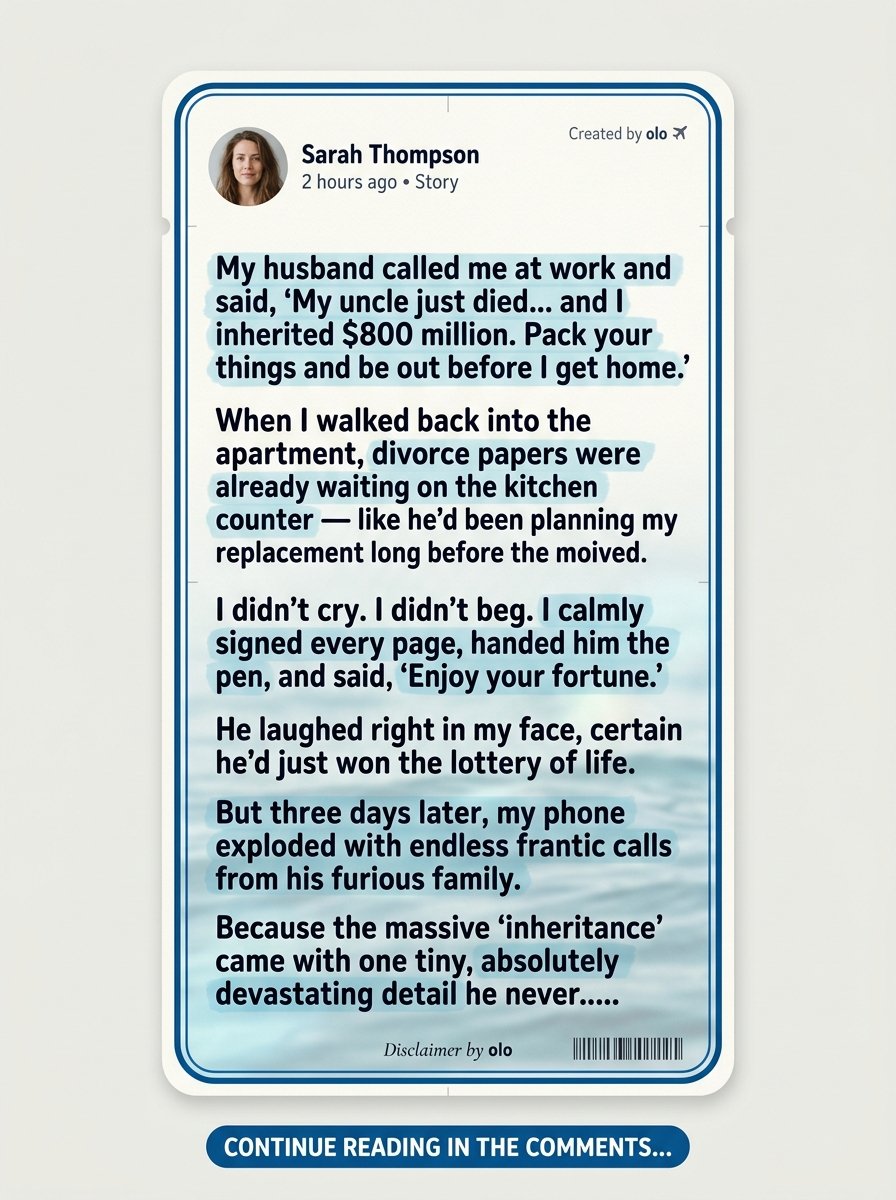
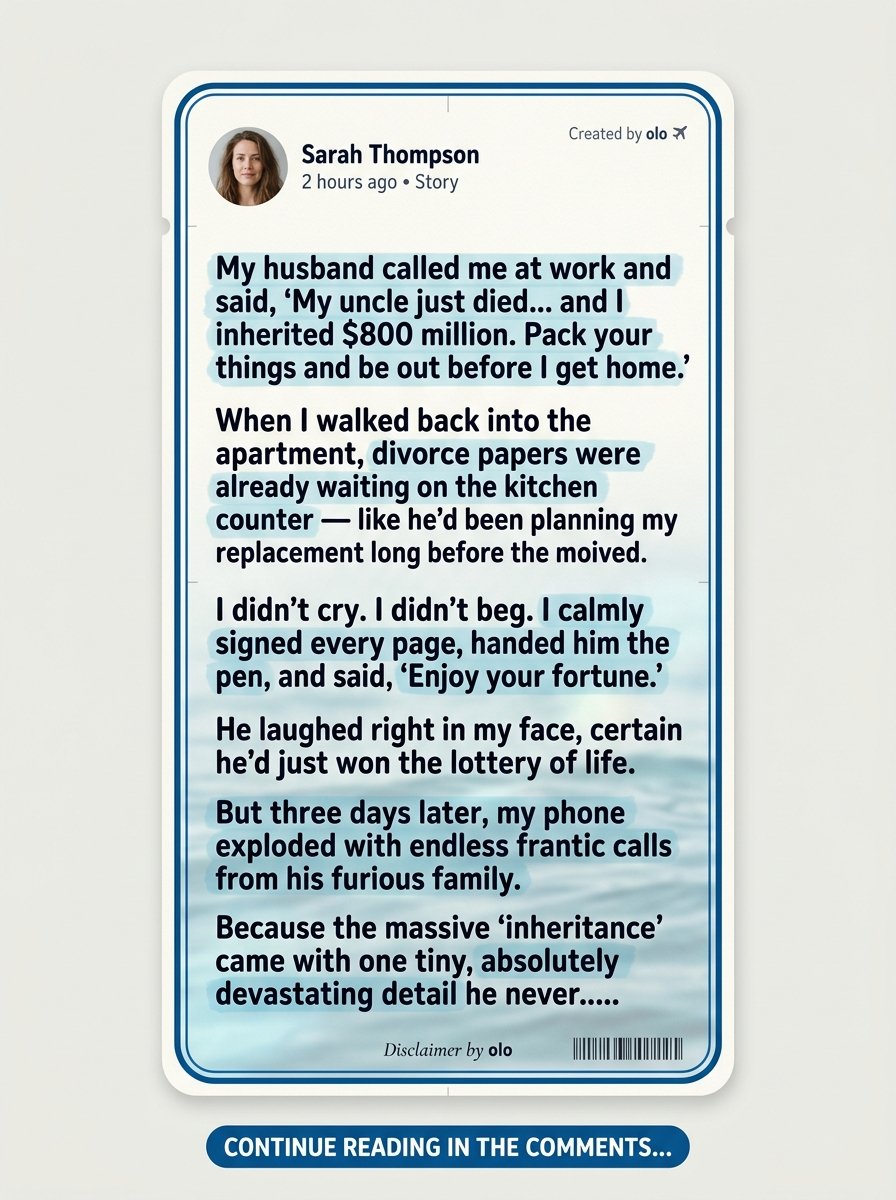
Three days after I signed the divorce papers, my phone started ringing nonstop.
First, it was my husband’s mother.
Then his sister.
Then a number I didn’t recognize.
I ignored every call until a voicemail from his mother made me stop.
“Please, you have to talk to us! Daniel says you know something about the inheritance. The lawyers are saying something is wrong!”
I sat down slowly.
Wrong?
I hadn’t done anything.
But I knew Daniel. He was greedy, impatient, and so blinded by the thought of $800 million that he hadn’t bothered to read anything carefully.
So I called him back.
He answered immediately.
“What did you do?” he shouted.
“Hello to you, too,” I replied calmly.
“Don’t play games! The attorneys say I can’t access the money!”
I almost smiled.
“Maybe you should ask them why.”
He went silent for a moment before spitting out, “My uncle left me everything! Eight hundred million dollars! It’s mine!”
“Then you shouldn’t have any trouble proving it,” I said.
He hung up.
That evening, I received a message from an attorney representing his late uncle’s estate. He explained that the inheritance was subject to a detailed trust agreement and several conditions Daniel was legally required to satisfy before any funds could be distributed.
The most important condition was buried deep inside the documents.
Daniel’s uncle had spent his final years watching his nephew closely. He knew about Daniel’s lavish spending, his growing debts, and his habit of treating people according to how much money he believed they were worth.
And he had one particular concern.
Daniel’s marriage.
The attorney couldn’t disclose every detail without following the proper legal process, but he confirmed that the estate documents contained provisions concerning Daniel’s marital status, financial obligations, and conduct.
I wasn’t sure what to believe.
Then the attorney asked me a question that made my blood run cold.
“Mrs. Carter, did your husband tell you that he planned to divorce you before or after learning the exact terms of the inheritance?”
“After,” I answered. “He called me at work the same day.”
There was a long silence.
“Please preserve every message and document you have. We may need them.”
That night, Daniel appeared outside my temporary apartment.
His expensive watch was gone. His shirt was wrinkled, and for the first time in years, he looked genuinely afraid.
“You need to help me,” he said.
I folded my arms.
“Help you with what?”
“The inheritance. My uncle’s attorneys are investigating everything. They say I may have violated the trust provisions.”
I stared at him.
“You told me to leave because you thought you were worth $800 million.”
“That isn’t what happened!”
“Really? Because I remember you telling me to pack my things before you got home.”
He lowered his eyes.
Then he said something I never expected.
“My uncle knew.”
“Knew what?”
Daniel swallowed hard.
“Everything.”
PART 3: The Inheritance Had One Final Condition
The following morning, I met with the estate attorney.
He explained that Daniel’s uncle had been a self-made billionaire who had built his fortune from nothing. He had also been married for nearly fifty years, and he believed loyalty meant more than money.
Before his death, he had arranged for his fortune to be placed in a complicated trust.
Daniel was named the primary beneficiary, but the inheritance was not an unconditional gift. The trust required compliance with its legal terms, and certain distributions could be delayed or restricted if specified conditions were breached.
The attorney was careful with his words.
“Your husband’s divorce does not automatically determine what happens to the inheritance,” he explained. “But his conduct, his financial disclosures, and his compliance with the trust are now under review.”
Then he showed me a letter Daniel’s uncle had written months before his death.
It wasn’t addressed to Daniel.
It was addressed to me.
I recognized the handwriting immediately. I’d met his uncle only a handful of times, but he had always treated me with warmth and respect.
The letter began:
Dear Emily,
If you are reading this, I suspect Daniel has already learned about the money.
I hope I’m wrong about what he will do next.
For years, I have watched him become increasingly obsessed with wealth. I tried to teach him that money reveals character rather than creates it. Unfortunately, I fear he has learned the wrong lesson.
My hands began to tremble.
The letter continued.
I cannot tell you what choices to make, and I will not ask you to remain in a marriage that makes you unhappy. But I want you to know that I have made arrangements to protect the people who deserve protection, within the limits of the law.
Please do not let anyone convince you that your worth depends on what you own.
I couldn’t finish reading without crying.
Not because of the money.
Because someone had seen what I had endured while everyone else assumed Daniel was a wonderful husband.
The attorney explained that I wasn’t automatically entitled to any portion of the inheritance. The divorce and the trust were separate legal matters, and the courts would determine any disputed financial issues.
But Daniel’s situation was deteriorating.
Investigators had discovered that he had made false statements about certain debts and financial obligations. His uncle’s advisers were also examining whether he had attempted to conceal assets before the inheritance was finalized.
The trust’s administrators suspended the proposed distribution while they investigated.
And the $800 million Daniel had already begun spending in his imagination?
He couldn’t touch it.
A week later, he called me.
This time, he wasn’t shouting.
“Emily, please. I need you.”
“What do you need?”
“I need you to tell them we were still together when I learned about the inheritance.”
I closed my eyes.
There it was.
Even now, he wasn’t asking whether I was okay. He wasn’t apologizing for humiliating me. He wanted me to lie for him.
“No,” I said.
“You’re destroying my life!”
“No, Daniel. I’m refusing to lie to save it.”
He began crying.
He told me he was sorry. He promised to change. He said he had panicked and made a terrible mistake.
For a moment, I remembered the man I had married.
Then I remembered the divorce papers on the kitchen counter.
“I hope you figure out who you want to be,” I told him. “But you won’t use me to escape the consequences of your choices.”
I ended the call.
Months passed.
The divorce was finalized, and the estate’s legal review continued. Daniel eventually received only the distributions permitted under the trust after the administrators resolved the issues surrounding his eligibility and financial disclosures. The exact amount remained private.
His family blamed me at first, but the evidence spoke for itself.
I never received the $800 million.
I didn’t need it.
I rebuilt my life, returned to work, and moved into a small apartment filled with sunlight. I started traveling, reconnected with old friends, and discovered how peaceful life could be when I no longer had to make myself smaller to protect someone else’s ego.
One afternoon, a letter arrived from Daniel.
Inside was a single page.
I thought money would make me untouchable. Instead, it showed me exactly who I had become. I don’t expect you to forgive me, but I am sorry.
I read it twice, folded it neatly, and put it away.
Forgiveness, I realized, didn’t mean reopening a door I’d finally found the courage to close.
Daniel had believed that inheriting $800 million made him more valuable than the woman who had stood beside him for years.
He was wrong.
His uncle’s greatest lesson wasn’t about money, marriage, or even loyalty.
It was about character.
Daniel spent his inheritance chasing the illusion of power. I walked away with something he could never buy: my dignity, my freedom, and a life that finally belonged to me.
THE END.