Part 1: The Question That Changed Everything
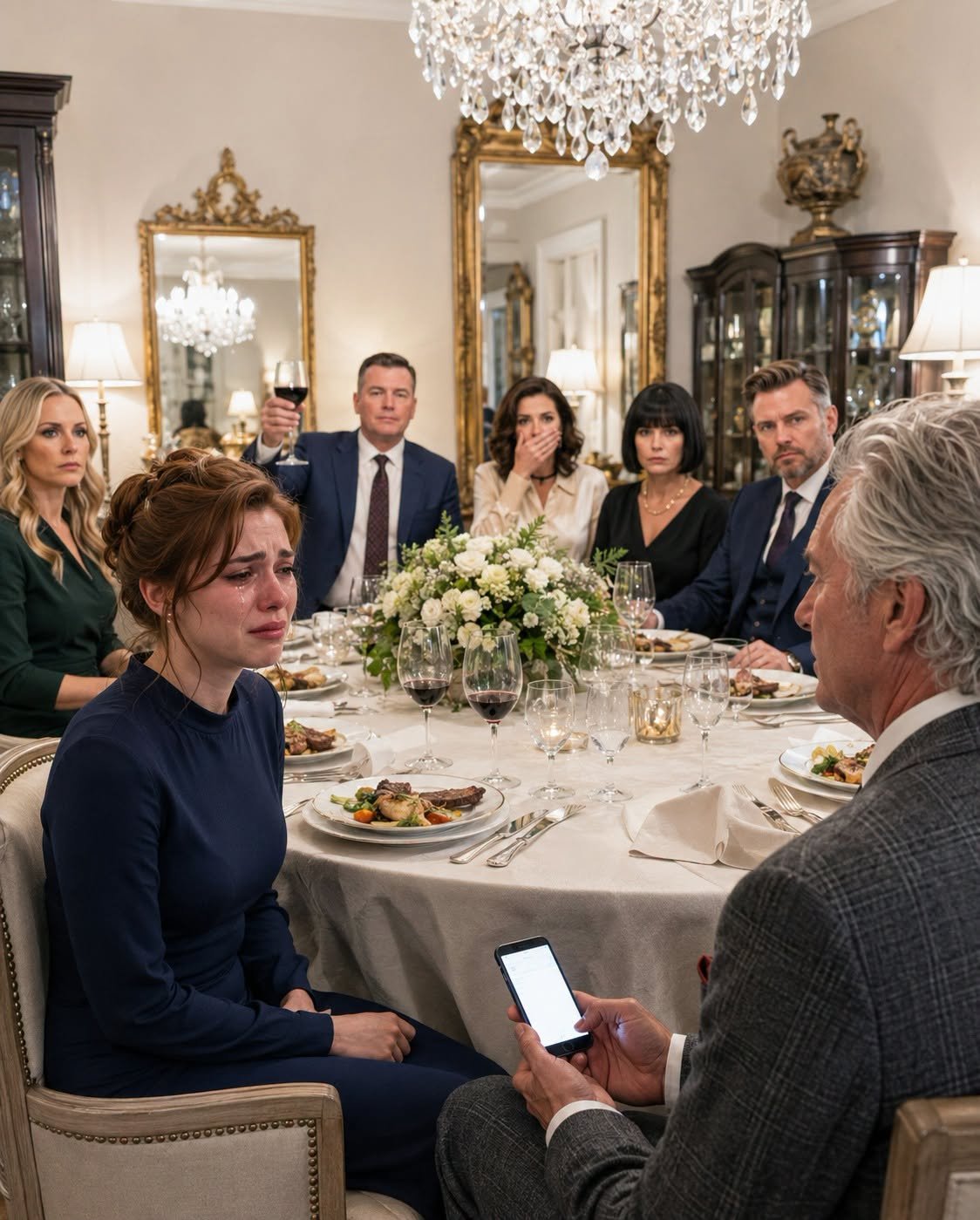
My father asked only one question, yet the moment those words left his mouth, every conversation around the dining table died.
“Why did you arrive in a taxi, Jenna?” he asked quietly. “Where is the Honda Civic I gave you?”
The clink of silverware stopped.
Across from me, my husband, Patrick Collins, continued slicing his steak with slow, deliberate movements, as though nothing unusual had happened. He didn’t look nervous. He didn’t look guilty.
He looked comfortable.
For three years, I had become an expert at translating Patrick’s behavior into something kinder than it really was.
When he mocked my opinions in front of friends, I called it his sense of humor.
When he criticized every dollar I spent, I convinced myself he was simply trying to help us budget.
When he used my credit card without asking, I reminded myself that marriage required trust.
Every excuse I made protected him a little more while costing me a little more.
Most of that money never benefited us.
It always found its way to his mother.
At first, Patrick insisted she couldn’t afford her medication.
A few weeks later, her car supposedly needed expensive repairs.
Then came church donations.
New tires.
Birthday presents.
Medical bills I was never allowed to see.
Every request was presented as temporary.
Every objection I raised somehow became proof that I lacked compassion.
Whenever I asked for receipts or questioned another withdrawal from my account, Patrick sighed dramatically before saying the same thing.
“She’s my mother, Jenna. One day you’ll understand.”
Somehow, caring about our own finances always made me the selfish one.
Looking back, I realize my father noticed the changes in me long before I admitted there was a problem.
He noticed how I glanced at Patrick before answering simple questions, almost asking permission without speaking.
He noticed that I tensed whenever anyone mentioned money.
He noticed I laughed less.
My father had always lived by one rule with his adult children.
He would offer advice once.
Only once.
After that, he waited for us to decide whether we were ready to hear it.
Six months before that family dinner, he handed me the keys to a silver Honda Civic.
It wasn’t flashy.
It wasn’t expensive.
It was practical, dependable, safe, and exactly the kind of gift my father believed mattered most.
“This belongs to you,” he said as he placed the keys into my hand.
He looked directly into my eyes before continuing.
“Not to your household.”
A brief pause.
“Not to Patrick.”
Another pause.
“To you.”
Those words felt oddly specific at the time.
Along with the keys came a thick folder containing the insurance papers, registration documents, maintenance records, and every piece of paperwork connected to the vehicle.
Attached to the front was a yellow sticky note written in my father’s neat handwriting.
Keep this folder in your desk. Never leave it inside the glove compartment.
I smiled, teasing him for being overly cautious.
He simply smiled back.
“I’ve learned that paperwork has a strange habit of becoming important exactly when people believe it isn’t.”
I didn’t understand what he meant.
Not then.
The Civic quietly gave me pieces of my independence back.
For the first time in years, I could leave for work without asking Patrick whether he needed the car.
I could visit my parents after work.
I could stop at the grocery store.
I could meet friends for coffee.
I no longer had to explain every destination before leaving the house.
It wasn’t just transportation.
It was freedom.
Perhaps Patrick sensed that before I did.
At first, his comments sounded harmless.
“My mom’s car is falling apart.”
A week later, he tried again.
“You barely drive yours on weekends.”
Soon his tone changed.
“It seems unfair that you have a reliable car while my mother struggles.”
I looked at him over dinner.
“My father gave that car to me.”
“So?”
“So… it’s mine.”
Patrick shrugged.
“I’m just saying she needs it more.”
“No.”
He frowned.
“No?”
“No.”
He asked again a few days later.
The answer remained the same.
Then again.
And again.
By the third conversation, something had changed.
He no longer argued because he expected me to agree.
He argued because he believed my opinion no longer mattered.
The following Thursday, I finished work just after five o’clock.
I walked into the parking garage carrying my laptop bag and automatically looked toward my usual parking space.
It was empty.
I froze.
For several terrifying seconds, I genuinely believed someone had stolen my car.
My heartbeat pounded in my ears as I searched every row twice.
Nothing.
Hands shaking, I called Patrick.
No answer.
I called again.
Straight to voicemail.
Again.
Nothing.
Exactly six minutes later, my phone vibrated.
A single message appeared on the screen.
Don’t start. Mom needed it. We’ll talk when you get home.
I stared at those words until they blurred.
He hadn’t borrowed my car.
He hadn’t asked.
He had taken it while I was at work…
…and given it to his mother.
I took a taxi home in complete silence.
Patrick was already sitting on the sofa watching television as though it were an ordinary evening.
“You overreact to everything,” he said before I could even speak.
“People survive perfectly well without cars.”
“You took my car.”
“Our car.”
“No,” I replied quietly. “My father made that very clear.”
He rolled his eyes.
“You’ll get over it.”
An hour later, his mother sent me a text.
Thank you for understanding sacrifice. You’re a wonderful daughter-in-law.
I read it three times.
Sacrifice.
The word echoed in my mind.
Sacrifice was supposed to be something a person chose freely.
No one had asked me.
Nothing had been voluntary.
Someone else had made the decision and expected gratitude afterward.
For nearly two weeks, I told no one.
Not my parents.
Not my brother.
Not my closest friends.
Instead, I started collecting evidence.
I saved every text Patrick sent.
Every credit card notification.
Every taxi receipt.
I photographed the empty parking space outside my office.
I made copies of bank statements.
I didn’t know exactly what I was preparing for.
I only knew that Patrick had become frighteningly good at making me question my own memory.
If I didn’t write things down, eventually he’d convince me they had never happened.
By the time my parents hosted their monthly family dinner, exhaustion had settled into my bones.
At exactly 7:18 p.m., my taxi pulled into their driveway.
Patrick had arrived earlier.
He was already seated comfortably at the dining table, chatting with my cousins as though he had absolutely nothing to hide.
My father watched me step through the front door.
His eyes traveled from my purse to my shoes before lingering briefly on the empty driveway outside.
He noticed everything.
I hadn’t even taken my seat before he spoke.
“Jenna.”
I looked up.
“Why did you arrive in a taxi?”
My mouth opened automatically.
I was about to lie.
I had already prepared the excuse.
The car is being serviced.
Protecting Patrick had become such an instinct that the lie reached my lips before the truth ever could.
But Patrick answered first.
“I gave it to my mother,” he said casually, cutting another piece of steak. “She needed it more.”
He explained, without a hint of embarrassment, that his mother’s old car was embarrassing, that I could simply take taxis, and that it made perfect sense for him to decide where the Civic belonged.
He spoke as though the decision had always been his to make.
Silence settled over the table.
No one moved.
No one interrupted.
My father simply looked at Patrick for several long seconds.
Then the corners of his mouth lifted into a calm, almost unreadable smile.
“I understand,” he said softly.
Patrick visibly relaxed.
He thought the conversation was over.
He thought he had won.
Then, hidden beneath the white tablecloth, my father slipped one hand into his pocket, unlocked his phone, and quietly sent a single message.

Part 2: The Car He Never Owned
Dinner continued, but nothing felt the same.
Conversations restarted in awkward fragments.
My aunt tried asking my cousin about work.
Someone reached for another bread roll.
Silverware scraped against porcelain.
Yet every person at the table kept stealing glances toward Patrick.
He didn’t seem to notice.
Or perhaps he noticed and mistook everyone’s silence for acceptance.
He leaned back comfortably in his chair, poured himself another glass of iced tea, and began talking about a potential business investment one of his friends had introduced him to.
“It’s all about timing,” he said confidently. “The people who hesitate always lose.”
No one responded.
My father quietly buttered a dinner roll.
My mother lowered her eyes to her plate.
I sat perfectly still, trying to calm the storm inside my chest.
Patrick believed the uncomfortable moment had passed.
He had no idea my father had already set something into motion.
Barely three minutes later, Patrick’s phone rang.
He smiled when he glanced at the screen.
“It’s Mom.”
There was almost pride in his voice.
He tapped the speaker icon off, stood halfway from his chair, then seemed to think better of it and sat back down.
“Hey, Mom.”
The smile disappeared almost immediately.
“What?”
A pause.
His eyebrows drew together.
“What do you mean they’re taking it?”
Everyone at the table looked up.
Patrick’s face drained of color.
“Slow down. Tell me exactly what’s happening.”
Another pause.
“No, don’t sign anything.”
His voice grew louder.
“Mom… listen to me.”
My father’s phone vibrated.
He picked it up calmly and glanced at the screen.
Without saying a word, he turned it slightly toward me.
A photograph filled the display.
My silver Honda Civic sat beneath the bright lights of a gas station just outside Patrick’s mother’s church.
A tow truck was parked in front of it.
Patrick’s mother stood beside the driver’s door, waving both hands angrily while arguing with a man carrying a clipboard.
At the top of the report displayed on my father’s phone was a familiar heading.
Hale Surgical Associates
I stared at it.
Then everything clicked into place.
The yellow note.
The paperwork.
The strange warning about keeping the documents in my desk.
My father hadn’t simply purchased the Civic through a dealership.
He had obtained it through the employee vehicle assistance program connected to his medical practice.
Although the vehicle had been assigned exclusively to me, the program maintained legal protections preventing unauthorized transfers.
Ownership couldn’t simply be handed to another person because someone felt entitled to do so.
Patrick had never possessed that authority.
Neither had his mother.
The man standing beside the tow truck wasn’t a police officer.
He wasn’t an ordinary towing contractor either.
He was the fleet compliance manager responsible for recovering vehicles assigned through the medical program whenever their legal status had been violated.
While everyone else thought my father had quietly accepted Patrick’s explanation…
…he had already contacted him beneath the table.
Patrick slowly lowered his phone.
For the first time since we’d married, genuine fear flickered across his face.
He looked toward my father.
“Richard…”
My father carefully placed his knife and fork together on his plate before folding his hands.
“You gave away a vehicle that was never yours.”
Patrick forced a laugh.
“Oh, come on.”
No one laughed with him.
“It’s family,” he said.
My father nodded once.
“Exactly.”
His voice remained calm.
“That is precisely why I asked the question in front of family.”
Patrick shifted uneasily.
“You don’t have to make this into some legal issue.”
“I didn’t.”
My father held his gaze.
“You did.”
Patrick opened his mouth, searching for another excuse.
“It was only temporary.”
“You never asked Jenna.”
“I knew she’d eventually agree.”
“You mean,” my father corrected quietly, “you hoped she’d stop arguing.”
Patrick’s jaw tightened.
My father extended one hand toward him.
“Put your mother on speaker.”
Patrick hesitated.
“I don’t think that’s necessary.”
“It is.”
The room became completely silent.
Finally, Patrick pressed the speaker button.
His mother’s furious voice immediately echoed through the dining room.
“This man is trying to tow my car!”
“No,” my father interrupted politely.
“Mrs. Collins, it is not your car.”
She ignored him.
“Patrick promised me it belonged to me! He said Jenna wasn’t using it!”
My father waited until she stopped speaking.
“The Honda Civic has never belonged to Patrick.”
Another pause.
“It was assigned to Jenna.”
“The gentleman standing beside you is Mr. Alvarez, our fleet compliance manager.”
“He has documents confirming the vehicle was transferred without authorization.”
“I advise you to hand him the keys and sign the recovery release.”
Silence answered him.
Then Patrick’s mother spoke again, though her voice had lost nearly all its confidence.
“Patrick told me Jenna agreed.”
Every eye at the table turned toward me.
I took a slow breath.
“I never agreed.”
Those three words sounded stronger than I expected.
My voice didn’t shake.
I didn’t look away.
Patrick spun toward me.
“You could’ve helped my mother.”
Even now…
Even after stealing my car…
Even after lying to everyone…
He still wanted me to believe I was the selfish one.
My father didn’t even acknowledge the accusation.
Instead, he looked directly at me.
“Jenna.”
I met his eyes.
“Would you like your car returned here tonight…”
He paused.
“…or would you prefer it delivered back to your apartment?”
The question hit me harder than anything Patrick had said all evening.
Nobody had asked what I wanted in months.
Every decision in my marriage had become a negotiation centered around someone else’s needs.
Patrick.
His mother.
His plans.
His emergencies.
His priorities.
Suddenly, someone was asking about mine.
“I’d like it brought here,” I answered quietly.
My father’s expression softened.
“It will be.”
Patrick stared at me as though I had betrayed him.
“You’re seriously doing this?”
I looked at him for a long moment.
Then I shook my head.
“No.”
He frowned.
“You did this.”
The words came more easily than I expected.
“I’m simply done paying the price for it.”
The room remained silent.
Then my older brother pushed back his chair and stood.
A second later, my uncle stood beside him.
Then my cousin.
None of them threatened Patrick.
None of them raised their voices.
They didn’t need to.
Their quiet presence changed everything.
Patrick suddenly realized he wasn’t surrounded by people willing to excuse his behavior anymore.
He was surrounded by witnesses.
My father rose from his chair.
“Patrick.”
His tone remained perfectly courteous.
“I think it would be best if you waited in my study until your ride arrives.”
Patrick let out a short, nervous laugh.
“She’s my wife.”
My father’s face never changed.
“She is my daughter.”
A beat of silence passed.
Then he added the words I would remember for the rest of my life.
“More importantly…”
“…she is her own person.”
“It appears you’ve forgotten both.”
Patrick had no answer.
For the first time since I’d met him, confidence abandoned him completely.
I quietly excused myself and walked upstairs to my childhood bedroom.
The familiar room smelled faintly of cedar wood and lavender.
Everything inside it reminded me of a version of myself I barely recognized—a woman who laughed without asking permission and made decisions without fearing someone’s disappointment.
I locked the door.
Then I sat on the edge of the bed.
Only then did the tears finally come.
Not because my car had been taken.
Not because Patrick had lied.
But because, for the first time in years…
…someone had believed me before asking me to defend myself.
At exactly 9:16 p.m., I heard a gentle knock.
“It’s Dad.”
I opened the door.
He stepped inside carrying the Honda keys.
He placed them quietly on the dresser.
Beside them, he set down a thick folder.
Inside were copies of Patrick’s text messages admitting he’d taken the car.
The signed unauthorized transfer release completed by Patrick’s mother.
The vehicle recovery report.
Photographs documenting the recovery.
Every piece of evidence was neatly organized.
Nothing left to memory.
Nothing left to manipulation.
My father rested one hand gently on my shoulder.
“You don’t have to decide everything tonight.”
I looked down at the keys.
Then at the folder.
Finally, back at him.
It was the kindest sentence anyone had spoken to me in a very long time.
For the first time in years…
I believed I actually had a choice.

Part 3: The First Step Toward Freedom
I didn’t make every decision that night.
But I made the first one that truly mattered.
I wasn’t going home with Patrick.
That single choice felt impossibly heavy, yet strangely peaceful. For years I had convinced myself that every argument could be repaired if I simply tried harder, apologized first, or ignored one more insult. Sitting in my childhood bedroom with my father’s evidence folder beside me, I realized something that should have been obvious all along.
A marriage couldn’t be saved by one person pretending everything was fine.
When I came downstairs the next morning, my mother was already making coffee.
She looked up as I entered the kitchen.
“You sleep at all?”
I smiled weakly.
“A little.”
She wrapped both hands around my coffee mug before sliding it toward me.
“You don’t have to explain anything to me.”
Those words nearly brought me to tears again.
For so long, I had become accustomed to defending every feeling that simple understanding felt unfamiliar.
By eight o’clock, I was sitting at my parents’ dining room table with my laptop open.
One by one, I began untangling the financial knots Patrick had tied around my life.
I called my bank.
I removed him as an authorized user from every account carrying my name.
I canceled the credit cards he had regularly used without permission.
Every password changed.
Every online account received two-factor authentication.
Every automatic payment was reviewed.
With each completed task, another piece of control quietly returned to me.
Patrick called repeatedly.
I ignored every call.
Instead, I saved each voicemail.
By lunchtime, the messages had already begun changing.
The first sounded calm.
“Jenna, let’s talk. You’re overreacting.”
The second sounded irritated.
“This whole thing is embarrassing. Call me.”
The third was almost pleading.
“I’ll explain everything.”
By evening, the fourth message was angry.
“So you’re choosing your father over your husband?”
I saved that one too.
The following morning, my older brother accompanied me back to the apartment.
Neither of us expected Patrick to remain calm.
We were right.
The moment he unlocked the door, he tried smiling.
“There you are.”
His expression softened as though nothing unusual had happened.
“I’ve been worried.”
“I came for my belongings,” I replied.
His smile disappeared.
“Seriously?”
He looked toward my brother.
“Did Richard send you both?”
“No,” my brother answered evenly.
“She asked me.”
Patrick followed us through every room while I packed.
At first, he apologized.
“I shouldn’t have taken the car.”
A few minutes later, the apology shifted.
“I was only trying to help my mother.”
Soon that became another argument.
“You’ve blown this completely out of proportion.”
By the time I carried the second box toward the front door, he was no longer apologizing at all.
“You’re destroying our marriage over a car.”
I stopped walking.
For several seconds, I simply looked at him.
Then I answered quietly.
“No.”
He frowned.
“I’m leaving because you believed you could take something that belonged to me…”
“…and then convince me I should thank you for it.”
His mouth opened.
No words came out.
There was nothing left for him to say.
Patrick’s mother proved no different.
She called my phone eight times that afternoon.
When I finally listened to the voicemails, every message followed the same pattern.
“You’re selfish.”
“You’ve humiliated this family.”
“Patrick only wanted to help me.”
“I always knew you weren’t generous.”
By the next day, my father’s attorney had sent both Patrick and his mother a formal notice requesting that all future communication be made in writing.
The phone calls stopped almost immediately.
People like Patrick depended on confusion.
They relied on conversations that couldn’t be proven.
On memories they could rewrite.
On emotional reactions that blurred the facts.
Documentation removed that advantage.
Words captured on paper couldn’t be manipulated nearly as easily.
During the weeks that followed, the truth unfolded one document at a time.
I discovered charges on my credit cards I had never questioned because they were buried among ordinary purchases.
Restaurant bills.
Department store purchases.
Luxury salon appointments.
Online shopping orders.
They weren’t emergencies.
They weren’t medical expenses.
Many had paid for Patrick’s mother’s lifestyle.
There were also transfers Patrick had disguised with vague descriptions.
Family help.
Temporary loan.
Household expense.
None of them had benefited our household.
Then came something even harder to accept.
Several mutual friends quietly contacted me after hearing we had separated.
One conversation after another revealed the same story.
Patrick had spent years telling people I was irresponsible with money.
That I constantly overspent.
That he struggled to manage our finances because I lacked self-control.
The irony made me laugh.
A painful, bitter laugh.
While secretly using my accounts to finance his own generosity, he had convinced others that I was the reckless one.
The Civic hadn’t been the beginning.
It had simply been the first theft arrogant enough to happen in public.
Once the illusion cracked, everything else became impossible to ignore.
The divorce itself wasn’t dramatic.
There were no screaming matches inside courtrooms.
No furniture thrown across rooms.
No revenge plots.
Real endings rarely looked like that.
Instead, they looked like paperwork.
Bank statements.
Property inventories.
Password changes.
Signatures.
Meetings with attorneys.
Cardboard boxes stacked in quiet apartments.
The silence after someone moved out.
Some evenings, loneliness crept into the corners of my apartment.
I would wonder whether I had acted too quickly.
Whether I had been too harsh.
Whether marriages were supposed to survive things like this.
Whenever doubt appeared, I reached for the evidence folder my father had given me.
Inside it remained everything.
The text message:
Don’t start. Mom needed it. We’ll talk at home.
The recovery report.
The unauthorized transfer release signed by Patrick’s mother.
The photographs.
Every receipt.
Every statement.
Facts didn’t change simply because emotions did.
Patrick tried several different legal arguments during the divorce.
First, he claimed the car had all been one enormous misunderstanding.
The documents disproved that.
Then he insisted I had verbally agreed.
His own text messages contradicted him.
Later, he argued that my father had manipulated me into ending the marriage.
My attorney smiled before asking a question that quietly ended that discussion.
“If Patrick believed he needed permission from his father-in-law to avoid giving away property that belonged to his wife…”
“…what exactly does that say about Patrick’s understanding of marriage?”
No one had an answer.
Six months later, my life looked remarkably ordinary.
I drove to work every morning in the same silver Honda Civic.
The same dependable engine.
The same familiar steering wheel.
The same quiet comfort.
There was only one difference.
Near the rear bumper remained a small scratch left behind by the towing equipment during the recovery.
The repair shop told me it would be inexpensive to fix.
I thanked them.
Then I declined.
Friends occasionally asked why.
“It’s only cosmetic.”
I would smile.
“I know.”
But I never repaired it.
That scratch reminded me of something important.
Recovering what was taken doesn’t erase the damage caused when it was stolen.
Healing doesn’t mean pretending nothing happened.
Scars are proof that something survived.

Every time I loaded groceries into the trunk or parked outside my office, I caught sight of that faint mark.
Instead of remembering humiliation…
…I remembered freedom.
Sometimes I still think about that family dinner.
The silence after my father’s question.
Patrick confidently explaining why another person’s property belonged to his mother.
The soft blue glow beneath the white tablecloth as my father quietly sent one message that changed everything.
He never yelled.
He never insulted Patrick.
He never needed to.